Buying guide
How to choose a ping pong table
Six specifications decide whether a table is right for you, and the listing puts them in roughly the opposite order of importance. Here is the order to actually check them in.
By Ryder M. · Last updated October 16, 2026 · How we pick
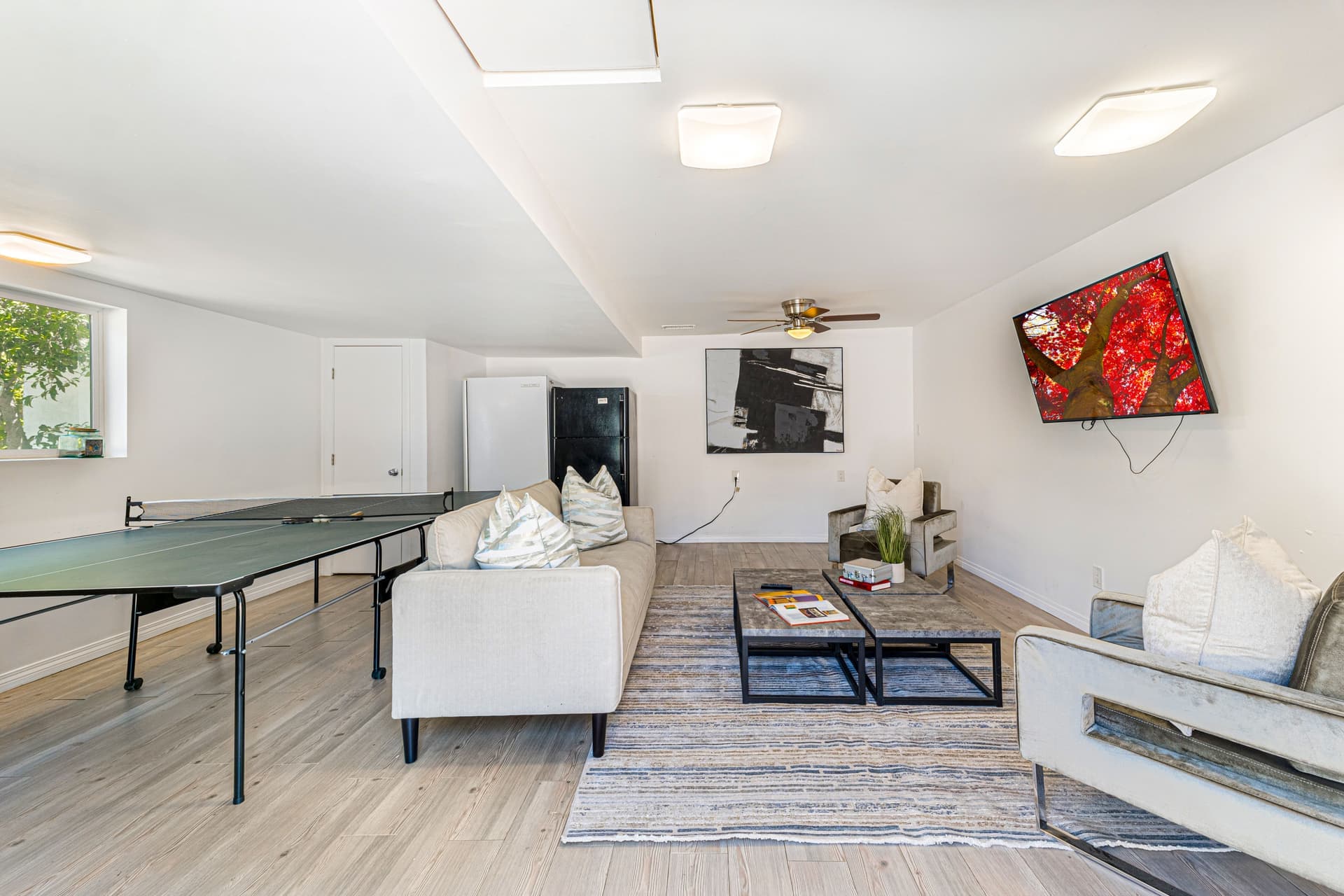
The short version: measure your room first, decide indoor or outdoor second, and only then look at top thickness. For most households the answer is a full-size indoor rollaway with a 16mm to 18mm top, bought from a brand whose fold mechanism is built for weekly use. If the room will not clear roughly 19ft by 11ft, buy a smaller table or a conversion top rather than squeezing a full-size one in — a table that is annoying to play on stops getting played.
Ping pong table listings are written to sell on the wrong things. Thickness gets a big number, the accessories get a long list, and the two facts that decide whether you will enjoy the table — whether the room fits it and whether the top can survive where you are putting it — are left to the buyer. This guide puts them back in order.
The baseline
What a full-size table actually is
A regulation table tennis table is 2.74m by 1.525m, standing 76cm high — about 9ft by 5ft and 30 inches tall — with a net 15.25cm high across the middle. Those figures come from the ITTF's own technical specification and they matter to a home buyer for one reason: a table advertised as full size should match them, and anything that does not is a midsize table being sold ambitiously.
There is nothing wrong with a midsize table, and for a lot of rooms it is the right answer. But it is a different product, and knowing the real numbers is what lets you tell which one you are being offered.
The first check
1. Measure the room before anything else
This is the specification nobody puts on a listing and the one that most often ruins the purchase. The table is 9ft by 5ft; the game needs run-back behind each end and side clearance for movement. For comfortable family play, aim for roughly 19ft by 11ft of clear floor. You can play in less, and plenty of people do, but every foot you take off the run-back pushes the game toward flat fast hitting and away from rallying.
| Clear floor | What that gives you | Verdict |
|---|---|---|
| 19ft x 11ft or more | Comfortable rallying, both players can step back | Buy full size |
| 16ft x 9ft | Playable family game, limited run-back | Full size works, expect close play |
| 13ft x 8ft | Serves and quick exchanges only | Consider midsize |
| Less than 13ft long | Wall collisions every rally | Midsize or a conversion top |
Measure the clear floor to the nearest obstruction at table height, not the total room size. Radiators, door swings and furniture all count.
Measure the folded footprint too, if the table will be parked between sessions. A rollaway that does not fit through the door of the room it is going in, or that cannot stand upright under a low basement ceiling, is a problem you find out about on delivery day. The full figures are in our room size guide.
The second check
2. Decide indoor or outdoor — and be honest about it
This is the decision that most commonly costs people the entire price of the table. An indoor top is MDF or particleboard with a painted finish. In a damp garage, a carport or outside, it absorbs moisture, swells at the edges and delaminates, and it is permanently ruined. Covers slow it down; they do not prevent it.
An unheated garage counts as outdoors for this purpose. So does a basement that gets damp in spring. If there is any real doubt, buy an outdoor composite top — you give up a little bounce quality and you keep the table. The options are in best outdoor ping pong tables.
The third check
3. Then look at top thickness
Thickness is the specification listings lead with, and it is genuinely the best single predictor of how an indoor table plays — just not the first thing to decide. Thicker tops absorb less energy and give a more consistent, livelier bounce. The bands are reasonably consistent across brands:
- 12mm to 15mm. Entry level. The ball comes off noticeably dead and the bounce varies across the table. Fine for young children, frustrating for adults.
- 16mm to 18mm. The family band, and where most households should buy. The bounce is honest and consistent enough that proper strokes work.
- 19mm to 22mm. Serious home play. Livelier and more even; the point at which a regular player stops being held back by the table.
- 25mm and up. Competition surfaces. Excellent, heavy, expensive, and wasted on a table that gets played twice a month.
The important caveat: a thick top on a flimsy frame wastes the top. Rigidity and thickness have to arrive together, which is why two tables with the same stated thickness can play quite differently. Our 15mm vs 25mm comparison goes through what each band actually feels like.
The fourth check
4. Check the frame and the fold mechanism
The undercarriage is the half of the table nobody photographs. What you want is a frame that holds both halves flat and level at the center join, because flex there is what makes the bounce change between the middle of the table and the corners. A heavier undercarriage at the same top thickness is usually the better table.
The fold mechanism matters at least as much, and for a different reason: it decides whether the table survives in a room that has another job. A mechanism that one adult can operate, with castors that lock positively, gets used every week. A heavy awkward one means the table gets left up, resented, and eventually sold. If the room is shared, treat the fold mechanism as a primary specification rather than a convenience.
The fifth check
5. Full size, midsize or a conversion top
If step 1 came up short, this is where you resolve it. A midsize table keeps the proportions and the net height, so strokes transfer, and it fits rooms a full-size table cannot. A conversion top gives you a genuinely full-size surface on a pool or dining table you already own, with no second footprint — at the cost of having somewhere dry and flat to store large panels and a two-person setup every time.
The decision is mostly about what you already own. A house with a slate pool table has the most rigid base available and should seriously consider a conversion top; a house without one is usually better off with a smaller real table. The trade-offs are set out in conversion tops and best small space ping pong tables.
The last check
6. Budget for paddles and balls separately
The paddles in the box are the cheapest item in the box, on every table at every price. They are usually a thin blade with hard, low-grip rubber, which means the ball will not take spin however well you hit it. A modest pair of real paddles changes how any table plays more than one thickness band does, and costs a rounding error against the table.
Balls are the same story in miniature: buy 40mm three-star balls in a multipack and stop thinking about it. Our best ping pong paddles roundup covers what to pair with the table you choose, including the honest point that a fast carbon paddle is the wrong first paddle for a complete beginner.
Quick picks
Tap any row to jump to the full write-up.
| # | Product | Best for | Price |
|---|---|---|---|
| 1 | 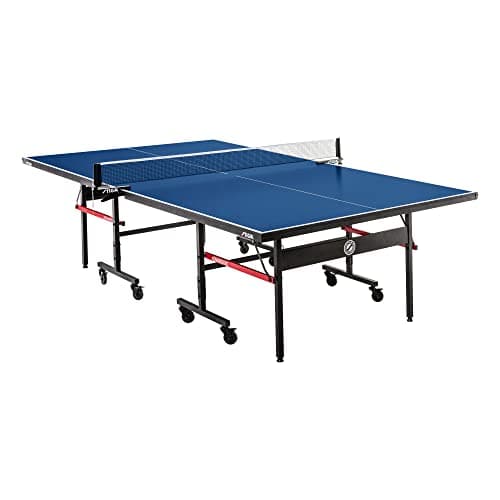 Best first table STIGA Advantage Table Tennis Table The default answer for a household buying its first full-size rollaway. | Most families, indoors, in a room that has another job | $455.90$599.9924% offView on Amazon |
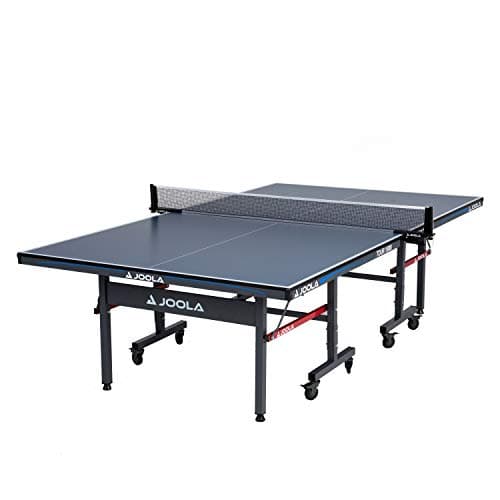
| 2 | 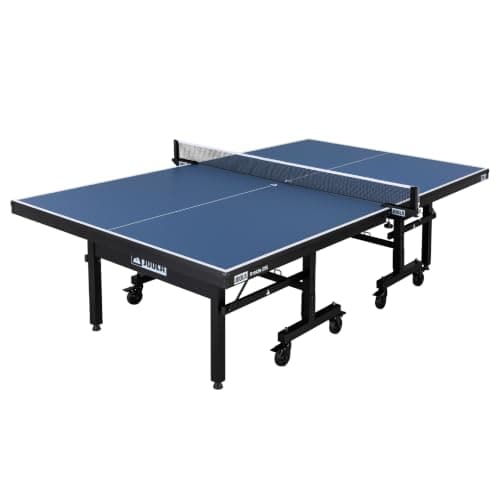 Best step up JOOLA Inside 25 Table Tennis Table A thicker top on a frame rigid enough to deserve it. | Households that will play weekly and notice an uneven bounce | $674.95View on Amazon |
| 3 | 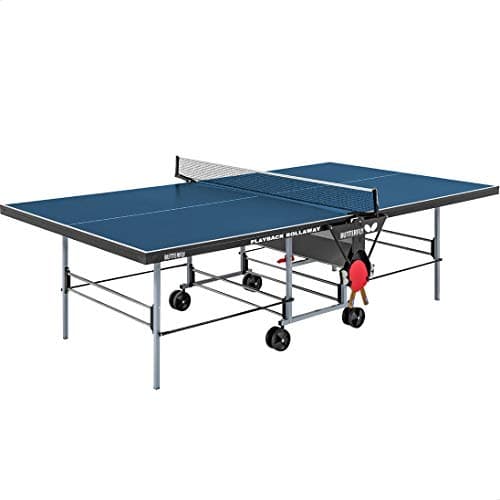 Best playing surface Butterfly Playback 19 Rollaway Table Tennis Table The most consistent bounce available at home prices, with playback mode included. | One serious player, or a household that wants the bounce to be right | $999.69View on Amazon |
| 4 | 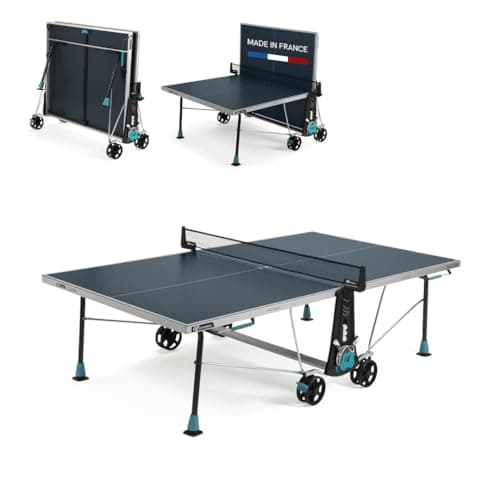 Best for a garage or patio Cornilleau 300X Outdoor Table Tennis Table A genuine weatherproof composite top that folds compact and stays outside. | Any table that will live somewhere unheated | $1,449.99View on Amazon |
| 5 | 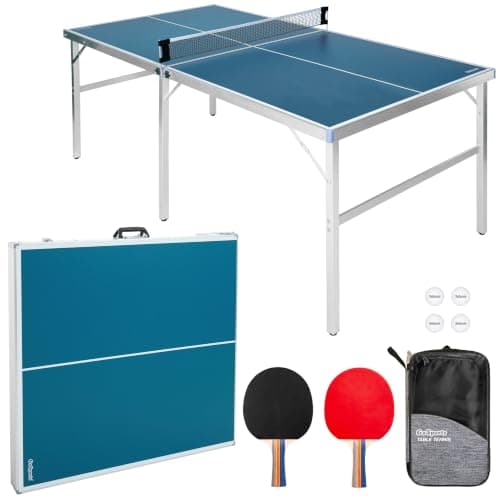 Best for a small room GoSports 6 ft Mid-Size Table Tennis Table A smaller table that is a real table, for rooms that cannot clear the full footprint. | Apartments, narrow basements and rooms that fail the clearance check | $159.99View on Amazon |
| 6 | 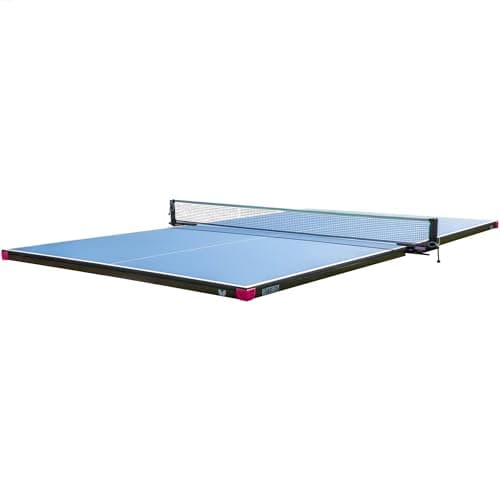 Best if you already have a table Butterfly Pool Table Conversion Top Full-size play on the pool or dining table you already own, with no second footprint. | Houses with a pool table or a big dining table and no room for another | $799.67View on Amazon |
#ad · Buy links are affiliate links and we earn a commission on qualifying purchases. Prices and product photographs come from the Amazon listing itself and are refreshed daily; the date they were last checked is shown under each buy button. Where a maker does not sell through Amazon there is no product photo, and the card below says so.
1. Best first table
STIGA Advantage Table Tennis Table
STIGA
Follow the checks on this page through for a typical household and you arrive here. It is a full-size indoor rollaway with a top in the family band, locking castors, and a fold mechanism built to be used weekly rather than demonstrated once — which is the specification that decides whether a table is still in the house in two years.
The bounce is honest rather than exceptional. A rally feels like table tennis and topspin behaves, which is the bar an entry table has to clear and frequently does not. You are not buying a competition surface and it does not claim to be one.
Replace the bundled paddles early. On every table at every price the paddles in the box are the cheapest item in it.
What we like
- Full-size play at the accessible end of the range
- Fold mechanism and locking castors built for weekly use
- Light enough for one adult to fold and park
- Nets and spare parts easy to find years later
Worth knowing
- Firm rather than lively bounce
- Some flex at the center join under hard play
- Indoor top — damp will destroy it permanently
Who it’s wrong for
A garage or a patio. An indoor top in an unheated space swells and never recovers.
#ad · We earn a commission on qualifying purchases. How this is funded · Price as of November 9, 2026
2. Best step up
JOOLA Inside 25 Table Tennis Table
JOOLA
The next real step is not a thicker top on its own — it is a thicker top with a frame underneath that can hold it flat. That pairing is what you are buying here, and it shows up as a bounce that stays the same from the middle of the table out to the corners.
Center-join flex is the thing you feel on a cheaper table without knowing what you are feeling: the ball comes off slightly differently depending on where it lands. A rigid undercarriage removes it. If anyone in the house plays properly, this is where the money starts being worth spending.
The costs are weight and money. It is heavier to fold and park, and a household that plays twice a month will not get the premium back in enjoyment.
What we like
- Noticeably more rigid at the center join
- Consistent bounce corner to corner
- Model numbering that tracks actual specification
- Strong first-party net and accessory range
Worth knowing
- Costs more than an equivalent-thickness family table
- Heavier to fold and move
- Rigidity is what casual players notice least
Who it’s wrong for
A household that has never played and is finding out whether it will. Start lower.
#ad · We earn a commission on qualifying purchases. How this is funded · Price as of November 9, 2026
3. Best playing surface
Butterfly Playback 19 Rollaway Table Tennis Table
Butterfly
If the deciding factor is how the table plays rather than what it costs, Butterfly is the reference at home prices. The tops are flatter and more consistent than anything else in this roundup, and playback mode — folding one half vertically so you can rally against it — makes solo practice possible without buying a robot.
This is the point on the ladder where you stop compromising on bounce and start paying for it. Whether that is worth it depends entirely on whether somebody in the house is going to practice, because a social player will not detect most of what the premium buys.
It is heavy and it wants a space of its own. Folding is possible but not casual.
What we like
- The most consistent top in this guide
- Playback mode for genuine solo practice
- Build quality that holds up under heavy use
- Brand recognition that holds resale value
Worth knowing
- Clearly the most expensive indoor option here
- Heavy — folding and moving is a two-person job
- Wasted on a household that plays occasionally
Who it’s wrong for
A family table that will mostly entertain children. Buy a mid-range table and good paddles with the difference.
#ad · We earn a commission on qualifying purchases. How this is funded · Price as of November 9, 2026
4. Best for a garage or patio
Cornilleau 300X Outdoor Table Tennis Table
Cornilleau
If the table is going in a garage, a carport or outside, the top material is not a preference — it is the whole decision. An indoor MDF top in an unheated space absorbs moisture, swells at the edges and is permanently ruined, and no amount of care prevents it. A weatherproof composite top does not care.
Cornilleau is the reference brand for this, and the crossover models fold to a genuinely compact footprint so the table can be parked against a wall between sessions. The lock and the castors are built for outdoor use rather than adapted to it.
The honest trade-off is bounce. A composite outdoor top plays slightly faster and flatter than a good indoor top, and the difference is real to a keen player. It is also completely irrelevant compared with owning a table that has not warped.
What we like
- Genuine weatherproof composite top, not a treated indoor one
- Folds compact enough to park against a wall
- Outdoor-rated hardware, locks and castors
- Removes the single most expensive mistake in this category
Worth knowing
- Costs more than an indoor table of similar quality
- Bounce is slightly faster and flatter than a good indoor top
- Heavy, and the frame is the point of the weight
Who it’s wrong for
A dedicated indoor games room, where the same money buys a better playing surface.
#ad · We earn a commission on qualifying purchases. How this is funded · Price as of November 9, 2026
5. Best for a small room
GoSports 6 ft Mid-Size Table Tennis Table
GoSports
If your room measurement comes up short, the answer is a smaller table rather than a full-size one squeezed in. A full-size table in a room without run-back turns every rally into a wall collision, and the table stops getting used — which is a worse outcome than a midsize table that gets played every week.
A midsize table keeps the geometry of the game: the net height and the proportions are right, so strokes transfer. It is not regulation and serious practice on it will build habits you then have to unlearn, but for a household that wants to play rather than train it is the correct compromise.
Check the folded dimensions as carefully as the open ones. In a small room, where the table parks matters as much as where it plays.
What we like
- Fits rooms that cannot take a full-size table
- Correct proportions, so strokes still transfer
- Lighter and easier to park than a full-size rollaway
- Considerably cheaper than a full-size table
Worth knowing
- Not a regulation surface — serious practice builds odd habits
- Shorter table rewards fast flat hitting over proper rallying
- Will feel small to anyone who has played on a full-size table
Who it’s wrong for
A household with the space for a full-size table. If the room clears, buy full size.
#ad · We earn a commission on qualifying purchases. How this is funded · Price as of November 9, 2026
6. Best if you already have a table
Butterfly Pool Table Conversion Top
Butterfly
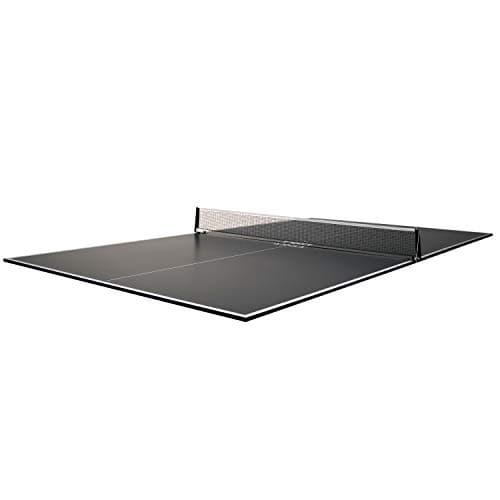
A conversion top is a full-size playing surface in panels that lifts onto a table you already have. For a house with a pool table, it is the cheapest route to full-size table tennis and it costs no floor space at all when the panels are stored.
The catches are storage and handling. The panels are large, heavy and awkward, they need somewhere flat and dry to live, and setting up is a two-person job every time. Households that do not solve the storage question end up never setting it up.
On the bounce: a good conversion top on a flat, rigid pool table plays better than a cheap folding table, because the pool table is the most rigid surface in the house. On a flexing dining table it plays worse. The base matters more than the panels.
What we like
- Full-size play with no additional floor footprint
- Much cheaper than a second table
- On a slate pool table, a genuinely rigid base
- Stores flat against a wall or under a bed
Worth knowing
- Panels are heavy and awkward — two people, every time
- Needs dry, flat storage or it warps
- Plays only as well as the table underneath it
- No net posts on some bases without a clamp kit
Who it’s wrong for
A household with nowhere dry and flat to store large panels. It will be set up twice and then never again.
#ad · We earn a commission on qualifying purchases. How this is funded · Price as of November 9, 2026
Ignore these
What not to buy on
- The accessory bundle. Four paddles, six balls and a spare net sounds generous and is worth very little. It is the cheapest way for a manufacturer to add perceived value.
- Thickness alone. A 19mm top on a flexing frame plays worse than an 18mm top on a rigid one.
- Brand without thickness. Two thickness bands apart matters more than which badge is on the apron. See best ping pong table brands.
- An indoor table "with a cover" for a garage. The cover does not save it. This is the single most expensive mistake in the category.
- Playback mode as a headline feature. Genuinely useful for solo practice, and genuinely irrelevant if nobody in the house will practice alone.
- Assembled dimensions only. If the table folds, the folded dimensions are the ones that decide whether you can live with it.
The decision
Putting it together
Worked through in order, the guide usually lands in one of four places. A household with space, playing indoors, buying its first table: a full-size rollaway in the 16mm to 18mm band from a brand with a good fold mechanism. A household with a regular player: the same, one or two thickness bands up, with the frame checked. A garage, carport or patio: an outdoor composite top, full stop. A room that fails the measurement: a midsize table, or a conversion top if there is a pool table to put it on.
On price, treat it as brackets rather than numbers. Entry family tables, mid-range tables with a proper frame, serious home surfaces and competition tables are four distinct tiers, and each step buys something specific — consistency of bounce, then rigidity, then the surface itself. Why ping pong tables are so expensive explains where the money actually goes, and ping pong table cost breaks the tiers down. Prices move constantly, so check the current price on any table before you commit.
One final thing worth saying: the best table for a household is the one that stays set up and gets played. That is usually not the most expensive one on the shortlist. It is the one that fits the room, survives where it lives, and folds easily enough that nobody resents it.
One piece of practical advice before you shop: search both names. The identical table is listed as a ping pong table and as a table tennis table, often at different prices, for reasons that go back to a 1901 trademark — see ping pong vs table tennis.
If the player is new to the game, the shortlist narrows in a useful way: full regulation geometry matters, a 25 mm competition top does not yet, and the bundled bats are the weakest part of any first purchase. Best beginner ping pong tables sets out what to buy now and what to leave until later.
Questions
Common questions
What size room do I need for a ping pong table?
What thickness ping pong table should I buy?
Can I keep an indoor ping pong table in the garage?
Is a more expensive ping pong table worth it?
Should I buy a conversion top instead of a table?
Do ping pong tables come with paddles?
What is the difference between a midsize and a full-size table?
Sources
Keep reading
Read next