Roundup
Best beginner ping pong tables
A first table should get the dimensions right and the expensive parts wrong. Paying for a competition top before anyone can rally is the most common way this money gets wasted.
By Ryder M. · Last updated October 30, 2026 · How we pick
Cue & Paddle is reader-funded. If you buy through a link on this page we may earn a commission, at no extra cost to you. It never changes which products we pick or how we rank them — read the full disclosure.
The top pick: the STIGA Advantage, because a beginner's table should get the regulation geometry right and spend nothing on the specifications they cannot yet use. It is full size — 2.74 m by 1.525 m, surface 76 cm up — on a 19 mm top rather than a competition 25 mm one, and it assembles quickly and rolls away. If one person is learning alone, buy a table with a playback fold instead. If the room cannot clear about 19 ft by 11 ft, a compact table is the honest answer.
The mistake that wastes the most money on a first table is buying for a player who does not exist yet. Competition top thickness, premium frames and tournament-grade nets all make a difference to someone who can already rally consistently, and none of them make a beginner better. The specifications that actually matter at this stage are the dimensions, the consistency of the bounce, and how little friction there is between deciding to play and playing.
Criteria first
What decides this purchase
1. Full size, if the room allows it. The playing surface should be 2.74 m long by 1.525 m wide at 76 cm high, with a 15.25 cm net. That geometry is the thing that transfers — a beginner who learns the real distances can play anywhere, and one who learns on a compact table has to recalibrate. If the room cannot clear it, a compact table is a reasonable compromise; if it can, this is not a place to save money.
2. Clear floor space, measured before anything else. A full-size table is 9 ft by 5 ft and needs roughly 19 ft by 11 ft to play on comfortably. This is the constraint people discover after delivery. Measure the room, then pick the table.
3. Bounce consistency over bounce height. A 19 mm top gives a slightly lower bounce than 25 mm, and no beginner can tell. What a beginner can be ruined by is an inconsistent surface — a dead patch, or a step at the join — because they will attribute the table's faults to their own stroke. Consistency is what a brand table buys you at this price.
4. Setup friction. How long it takes to assemble, how easily it folds, whether one person can move it. A table that is annoying to deploy gets played monthly instead of weekly, and frequency is the only thing that makes a beginner better.
5. Paddles and balls, budgeted from the start. The bats in the box are almost always the worst part of the purchase, and running out of balls is the commonest reason a new table goes unused. Add a four-paddle set and a box of 40 mm three-star balls to the order, not later.
6. What you do not need yet. A 25 mm competition top, a tournament net and post set, a carbon paddle, or an outdoor-rated surface for an indoor room. Every one of those is a real upgrade for a real player and a waste on a first table.
The comparison
Beginner specs against competition specs
| Spec | Beginner should buy | Competition spec | Why wait |
|---|---|---|---|
| Playing dimensions | Full regulation | Full regulation | Never compromise here if the room allows |
| Top thickness | 19 mm | 25 mm | Lower bounce is invisible to a beginner |
| Frame | Standard home rollaway | Heavy steel club frame | Matters only when players lean hard |
| Net and posts | Whatever ships with it | Clamp tournament set | Replace it when it sags, not before |
| Paddles | Four matched control bats | Carbon blade, tacky rubber | Fast rubber amplifies a loose stroke |
| Balls | 40 mm, one or two star | 40 mm three star | Practice balls play fine and cost less |
| Playback fold | Worth it if learning alone | Irrelevant | Only useful without a partner |
| Surface rating | Indoor | Indoor or outdoor by venue | Outdoor tops play worse indoors |
The 40 mm plastic ball has been the standard since the ITTF phased out celluloid in 2014, and games have been to 11 points with service alternating every two since 2001. Any set sold as 38 mm or a 21-point rulebook is old stock.
Quick picks
Tap any row to jump to the full write-up.
| # | Product | Best for | Price |
|---|---|---|---|
| 1 | 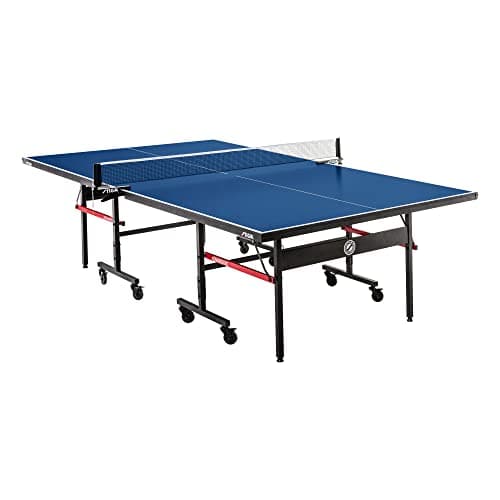 Best overall for beginners STIGA Advantage Table Tennis Table Regulation dimensions and a 19 mm top, assembled in under an hour. | A first full-size table for a household | $455.90$599.9924% offView on Amazon |
| 2 | 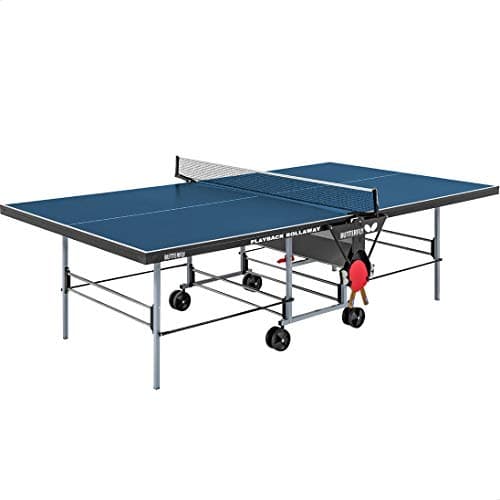 Best for solo practice Butterfly Playback 19 Rollaway Table Tennis Table A playback fold that lets one person practice without a partner. | One person learning the game deliberately | $999.69View on Amazon |
| 3 | 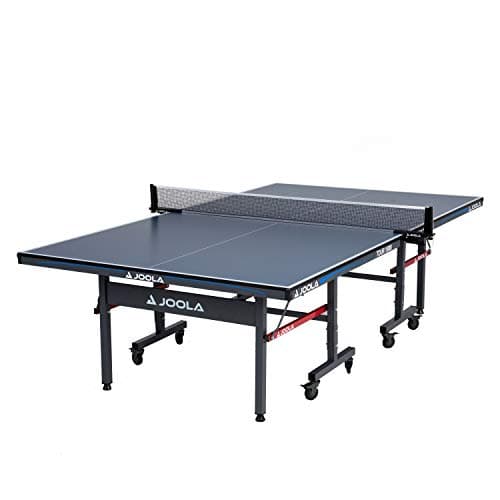 Best value full-size table JOOLA Tour 1800 Table Tennis Table A full regulation rollaway with a playback mode, from a competition brand. | A household that wants a brand table without paying for competition specs | $599.95View on Amazon |
| 4 | 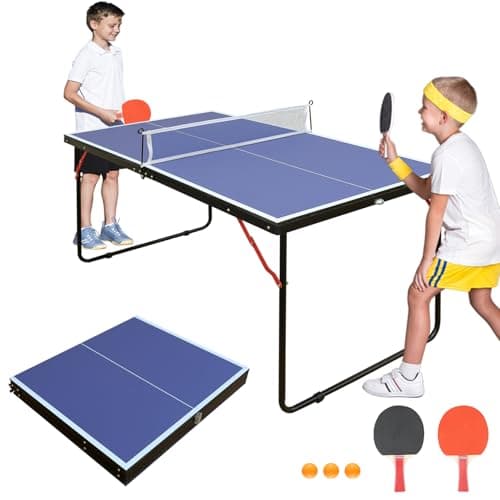 Best for a small room SculPong 4.5 ft Folding Table Tennis Table A 4.5 ft folding table for a room that cannot clear a full-size one. | Apartments and rooms under about 16 ft long | $88.99View on Amazon |
| 5 | 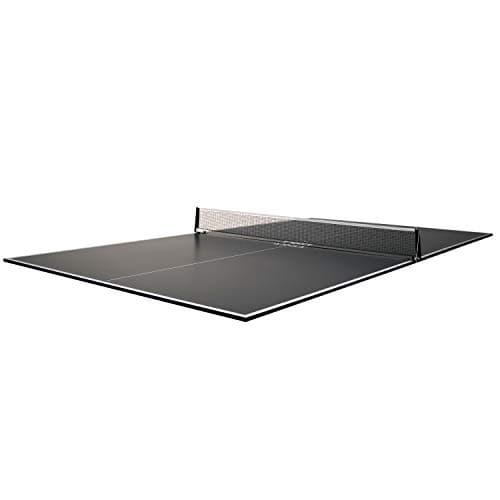 Best if you own a pool table JOOLA Regulation Table Tennis Conversion Top Regulation dimensions on a table you already own, stored flat between uses. | Households with a pool or large dining table | $249.95View on Amazon |
| 6 | 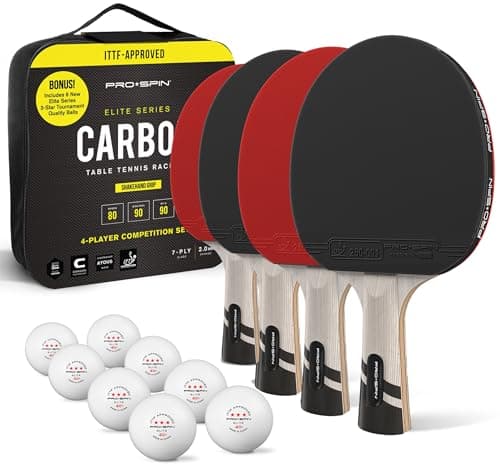 Best beginner paddles to buy with it PRO-SPIN 4-Player Ping Pong Paddle Set Four matched control paddles and balls — the right bats for a new table. | Every household buying a first table | $89.99View on Amazon |
#ad · Buy links are affiliate links and we earn a commission on qualifying purchases. Prices and product photographs come from the Amazon listing itself and are refreshed daily; the date they were last checked is shown under each buy button. Where a maker does not sell through Amazon there is no product photo, and the card below says so.
1. Best overall for beginners
STIGA Advantage Table Tennis Table
STIGA
This is the pick that gets the priorities in the right order for a beginner. It is a full regulation table — 2.74 m by 1.525 m with the surface 76 cm from the floor — on a 19 mm top rather than a competition 25 mm one. Everyone in the house learns the real distances, the real net height and the real timing, and you pay nothing for a top thickness nobody can yet exploit.
The practical specs matter more than the playing specs at this stage: it goes together quickly, it rolls away as two halves, and it is light enough for two people to reposition. A table that is awkward to set up is a table that gets played less, and for a beginner household that is the specification that decides everything.
The 19 mm top does give a slightly lower, deader bounce than 25 mm. A strong player notices immediately; a beginner does not, and will have outgrown the household long before the top is the limiting factor.
The frame is lighter than premium tables, which shows up as a little movement if somebody leans on the table. Worth knowing, not worth paying to avoid yet.
What we like
- Full regulation playing dimensions at a family price
- 19 mm top — the right thickness to start on
- Quick assembly; rollaway halves for storage
- Light enough for two people to reposition
- Everyone learns the real geometry from day one
Worth knowing
- 19 mm gives a lower, deader bounce than competition thickness
- Lighter frame moves slightly under a leaning player
- Basic net and post set
- Indoor only
Who it’s wrong for
A room that cannot clear the playing space — that is about 19 ft by 11 ft. See room size guide.
#ad · We earn a commission on qualifying purchases. How this is funded · Price as of November 9, 2026
2. Best for solo practice
Butterfly Playback 19 Rollaway Table Tennis Table
Butterfly
The single biggest predictor of whether a beginner improves is how often they can get to the table, and for most households that is limited by whether somebody else is free. A playback position folds one half vertical so the ball comes back, which turns a table into something you can use alone.
Butterfly is a competition brand, and the build reflects it — at around 157 lb assembled this is a solid full-size rollaway on a 19 mm top, light enough at the lower end of the category that one person can fold and wheel it.
The honest caveat about playback practice is that it builds some habits a partner would not. A vertical half returns the ball with no spin and from a fixed angle, so it is excellent for grooving a stroke and useless for learning to read an opponent. Use it for the former.
It is also the format that suits a shared room, because folded upright it takes a fraction of its playing footprint.
What we like
- Playback position makes solo practice genuinely possible
- Competition brand build on a full-size regulation table
- Around 157 lb — one person can fold and wheel it
- Stores upright against a wall
Worth knowing
- 19 mm top rather than competition 25 mm
- Playback returns have no spin, so they teach only stroke mechanics
- Castors want a reasonably flat floor
- Costs more than the entry picks
Who it’s wrong for
A household where four people always play. The playback feature is wasted and the money could go elsewhere.
#ad · We earn a commission on qualifying purchases. How this is funded · Price as of November 9, 2026
3. Best value full-size table
JOOLA Tour 1800 Table Tennis Table
JOOLA
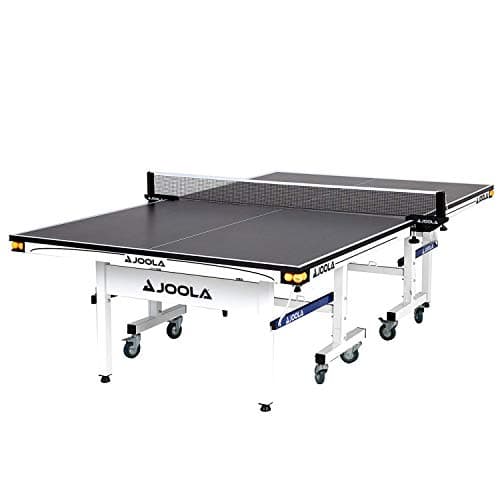
JOOLA makes tables used in sanctioned competition, and the Tour series is where that engineering reaches a home price. The result for a beginner is a full regulation table with a consistent bounce across the surface and a frame and undercarriage rather better than the price suggests.
Bounce consistency is the specification worth having at this stage, and it is different from bounce height. A cheap top can be the right thickness and still have a dead patch or a slight step at the join, and a beginner who cannot yet tell a bad bounce from a bad stroke will blame themselves for the table's faults. A consistent surface removes that.
It folds as a rollaway with a playback position, so it covers both the storage and the solo-practice requirement without buying a second table.
Being a brand table it is heavier and costs more than the budget end. For a household reasonably confident the game will stick, it is the better ten-year purchase.
What we like
- Competition brand engineering at a home price
- Consistent bounce across the whole surface
- Rollaway with a playback position
- Better frame and undercarriage than the price suggests
Worth knowing
- Heavier to move than the entry tables
- Needs real floor space in use
- Still a 19 mm-class top, not competition thickness
- Costs more than a first-try budget table
Who it’s wrong for
A household still finding out whether anyone will play. Start cheaper and upgrade once it sticks.
#ad · We earn a commission on qualifying purchases. How this is funded · Price as of November 9, 2026
4. Best for a small room
SculPong 4.5 ft Folding Table Tennis Table
SculPong
A full-size table needs roughly 19 ft by 11 ft to play on properly, and plenty of homes cannot offer that. When the choice is a compact table or no table, the compact table wins — a game that happens beats a geometry that does not.
At 4.5 ft this is firmly a compact table and the timing is different: the ball arrives sooner than it would in a real rally, so strokes grooved on it need adjusting on a regulation table later. For casual play and for children that costs nothing.
It folds and is light enough for one person to move and store, which in a small home is the specification that matters most.
Be clear about what it is. This is the right answer to a space constraint and the wrong answer to a budget constraint — if the room has the space, a full-size table at a similar price is a much better buy.
What we like
- Fits rooms a full-size table cannot
- Folds; one person can move and store it
- Cheapest practical way to have a table at all
- Fine for children and casual play
Worth knowing
- 4.5 ft is well short of regulation — timing differs
- Strokes learned on it need adjusting later
- Lighter frame flexes more
- A keen beginner will outgrow it quickly
Who it’s wrong for
A room with 19 ft of clear length. Buy full size — the geometry is the thing that transfers.
#ad · We earn a commission on qualifying purchases. How this is funded · Price as of November 9, 2026
5. Best if you own a pool table
JOOLA Regulation Table Tennis Conversion Top
JOOLA
If there is already a pool table in the room, a conversion top is usually the better first purchase than a table. It gives regulation playing dimensions, costs less than a full table, and takes no permanent floor space — the game simply uses the floor the pool table already occupies.
For a beginner that combination is strong, because the main reasons first tables stop being used are space and setup friction, and a conversion top removes one entirely.
The real constraint is storage, and it is strict: a conversion top must be stored flat. Leaned against a wall on edge for a year it develops a bow that cannot be taken out, which is how most of these get ruined.
It also needs the right size pool table underneath it and a sensible way to lift two or four large pieces. Check the sizing before buying — our conversion tops guide covers the fit rules.
What we like
- Regulation playing dimensions without a second table
- No permanent floor space needed
- Cheaper than a full-size table
- Pieces are light enough for one person
Worth knowing
- Must be stored flat or it bows permanently
- Needs a correctly sized pool table underneath
- Setup and takedown every session
- Protects neither the pool cloth nor itself if dropped
Who it’s wrong for
A household without a suitable table to put it on.
#ad · We earn a commission on qualifying purchases. How this is funded · Price as of November 9, 2026
6. Best beginner paddles to buy with it
PRO-SPIN 4-Player Ping Pong Paddle Set
PRO-SPIN
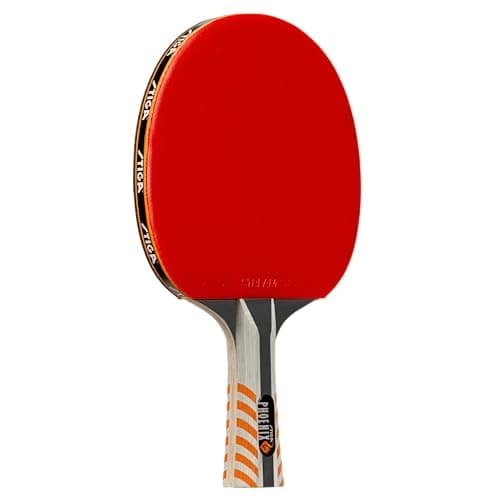
Almost every table ships with bats that are worse than the table deserves, and the bundled set is the commonest reason a new table plays disappointingly. Four matched paddles cost about what one decent individual bat costs and fix the problem for the whole household at once.
Matched is the operative word. Doubles only works if the bats play the same, and nobody wants to be the person stuck with the bad bat from the box. Four identical control-oriented paddles makes every game fair.
Control-oriented is the other half. Fast tacky tournament rubber amplifies the inconsistency in a beginner's stroke, so it produces wilder results rather than better ones — the slower bat is what makes mistakes legible and correctable. Our best ping pong paddles for beginners page goes through why.
The balls included matter more than they sound. Running out of balls is the single most common reason a new table stops getting used.
What we like
- Four matched paddles, so doubles plays fairly
- Control-oriented rubber suits a beginner's stroke
- Balls included — the consumable nobody remembers
- Costs about what one good individual bat costs
Worth knowing
- Molded bats; the rubber is not replaceable
- A player who improves will outgrow them within a year
- Generic handles rather than fitted grips
Who it’s wrong for
One person learning seriously with a coach — a single control bat teaches more.
#ad · We earn a commission on qualifying purchases. How this is funded · Price as of November 9, 2026
Where the money gets wasted
What a beginner table does not need
- A 25 mm competition top. It is the single biggest price jump in the category and the one a beginner benefits from least. The bounce is higher and livelier, which is harder to control, not easier.
- An outdoor table for an indoor room. Outdoor tops are aluminum or resin composite and play slower and deader than wood. Buy outdoor only if the table is genuinely going outside — see best outdoor ping pong tables.
- A premium paddle. Tournament rubber makes an unrefined stroke less predictable. Four control bats beat one fast bat for a beginner household every time.
- Three-star balls for practice. Three-star is a competition grade. One and two star balls play perfectly well in a basement and cost less, so you can buy more of them.
- A robot. Ball machines are excellent and they are a second-year purchase. Learn to rally first.
- A tournament net set. Replace the bundled net when it sags, which it will. Replacing it on day one is money spent early for no gain.
The inverse of this list is worth stating too: the things genuinely worth spending on at the start are full-size geometry, a surface with no dead spots, and four decent bats. Everything else can wait until somebody can rally twenty balls in a row.
This reasoning holds across the game room. Buying the children's version of a table for an older beginner is the same mistake in a different category — it is built around reach rather than play, and an adult-height player stoops over it. Best pool tables for teens works through the pool-table version of the same decision.
After it arrives
Setting a beginner up properly
- Assemble it in the room it will live in, not in the hallway. These are 150 lb-plus objects and moving one assembled is how tops get chipped.
- Level it where it stands. Roll a ball slowly along each line; if it drifts, adjust the feet on the low side. Floors are not flat, and an unlevel table teaches a beginner to compensate for a fault.
- Check the join. The two halves should sit flush. A step at the join is the most common cause of an inconsistent bounce on a new table and is usually adjustable at the undercarriage.
- Set the net to 15.25 cm across the full width, and tension it so it does not sag in the middle. A sagging net changes which balls are good and is the cheapest thing to get right.
- Buy more balls than you think you need. A box, not a sleeve. This is the single change that most increases how often a new table gets used.
- Agree the rules once. Games to 11, service alternating every two points, two clear points from 10-10. Settling that on day one avoids the argument that ends sessions.
The full setup sequence, including net tensioning and what to check on the surface, is in how to set up a ping pong table.
The verdict
Which to buy
- A first table for a household — STIGA Advantage. Regulation geometry, quick setup, nothing paid for specs nobody can use yet.
- One person learning alone — Butterfly Playback 19. The playback fold is what turns practice from a scheduling problem into a decision.
- Reasonably sure it will stick — JOOLA Tour 1800. Competition-brand consistency, rollaway and playback, the better ten-year buy.
- A room under about 16 ft — SculPong 4.5 ft folding. A compact table that gets played beats a full-size one that does not fit.
- Already own a pool table — JOOLA conversion top. Regulation dimensions, no extra floor space. Store it flat.
- Every one of the above — add the four-paddle set. The bundled bats are the weakest part of any first table purchase.
- Children are the main players — look at the kids' tables instead. Best ping pong tables for kids covers that buyer.
Prices move with season and freight across this whole category, so this page describes price positions in prose and leaves the figures to the live listing on each pick. Compare delivered cost — a full-size table is a heavy item and shipping can change the ranking.
Questions
Common questions
What is the best ping pong table for a beginner?
What thickness ping pong table do I need as a beginner?
Should a beginner buy a full-size ping pong table?
How much space does a beginner ping pong table need?
Do I need to buy paddles separately for a new table?
What ping pong balls should a beginner buy?
Is a cheap ping pong table worth it for a beginner?
Sources
Keep reading
Read next