Roundup
The best pool table accessories
A new table arrives with the cheapest version of everything. These are the five accessories worth replacing, in the order to replace them.
By Ryder M. · Last updated October 4, 2026 · How we pick
Cue & Paddle is reader-funded. If you buy through a link on this page we may earn a commission, at no extra cost to you. It never changes which products we pick or how we rank them — read the full disclosure.
The short answer: if the table is new, replace the cues first. Bundled cues are the cheapest part of any pool table package and the usual reason a new table stops getting used. After that, buy a fitted cover, then a wall rack, then good chalk — and leave the ball set until the cloth is worth it. That order gets the most play out of the least money.
This page covers the accessories around the table. If you are still choosing the table itself, start with the main pool table roundup; if you want one good cue rather than a house set, the cue roundup goes into weight, taper and tip in detail.
The order
What to buy first
| Priority | Accessory | The problem it solves |
|---|---|---|
| 1 | Full-length cues | Bundled cues are short, often warped, and badly tipped |
| 2 | Fitted cover | Dust, sunlight and pets age the cloth faster than play does |
| 3 | Wall rack | Leaning cues warp; loose chalk and triangles get lost |
| 4 | Good chalk | Miscues from coarse chalk that will not hold to the tip |
| 5 | Phenolic ball set | Bundled polyester balls are not round and scuff quickly |
| Later | Re-clothing, a hanging light | Both matter, neither is an accessory purchase |
This order assumes a full-size table that is actually played. On a compact or folding table, stop after the cover.
Quick picks
Tap any row to jump to the full write-up.
| # | Product | Best for | Price |
|---|---|---|---|
| 1 | Best first upgrade Aska House Cue Set (4-Pack) Four straight house cues in mixed weights — the fix for the warped pair in the box. | Any table that came with bundled cues | Check price on Amazon |
| 2 | 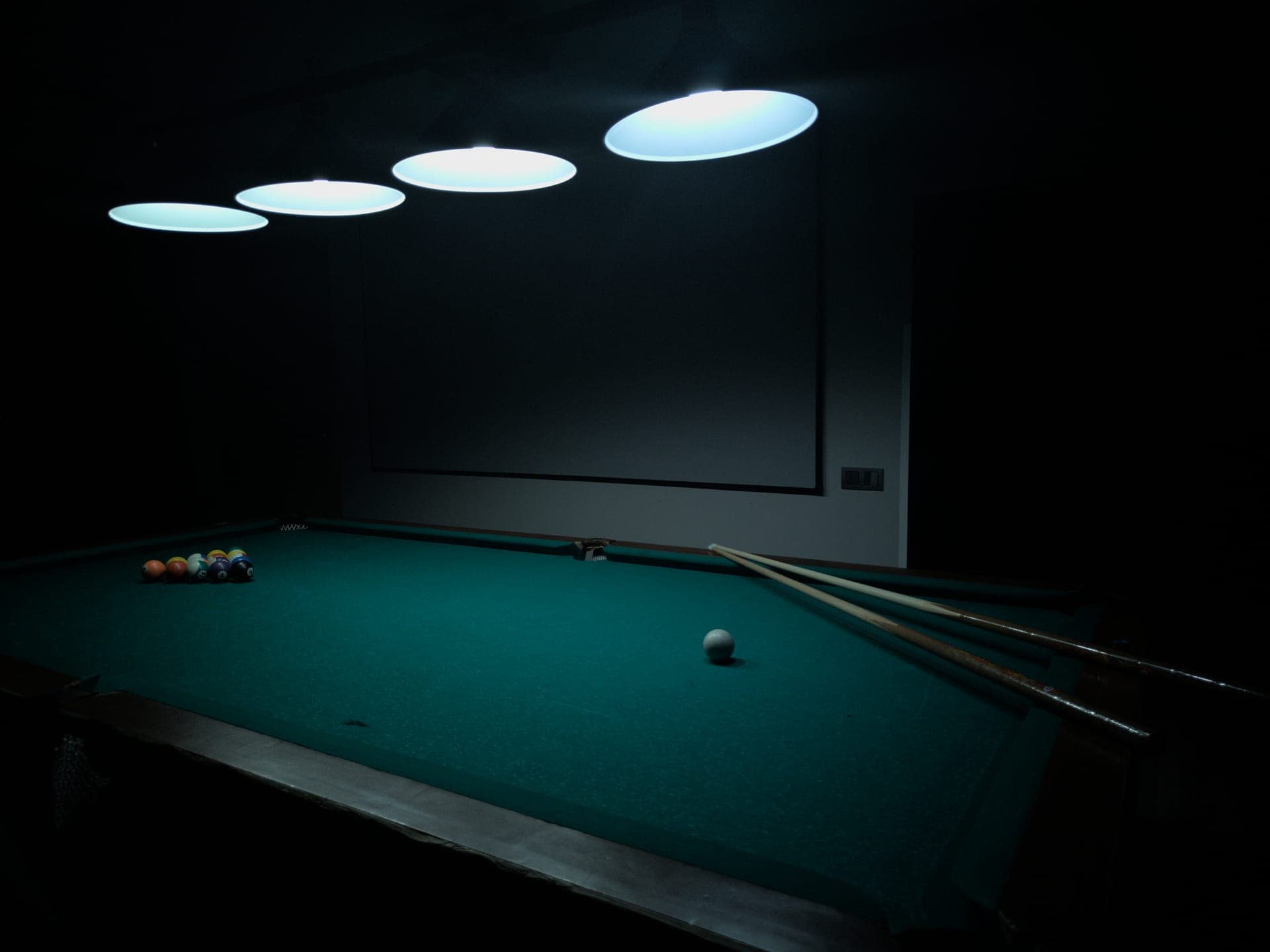 Best ball set Aramith Premier Billiard Ball Set Phenolic resin balls that roll true and stay round for a decade of play. | Anyone still using the set that came with the table | Check price on Amazon |
| 3 |  Best protection Heavy-Duty Fitted Pool Table Cover The cheapest insurance on the list: keeps dust, sun and pets off the cloth. | Tables in sunrooms, basements, or any house with pets | Check price on Amazon |
| 4 | Best storage Viper Wall-Mounted Cue Rack Wall-mounted storage that keeps cues straight and the floor clear. | Rooms where cues currently lean in a corner | Check price on Amazon |
| 5 | Best small gift Kamui Cue Chalk The accessory nobody buys for themselves and everybody notices. | A stocking filler for someone who owns everything else | Check price on Amazon |
#ad · Buy links are affiliate links and we earn a commission on qualifying purchases. Photographs are licensed images of the category, not of the individual unit — see each retailer listing for the product’s own photography.
1. Best first upgrade
Aska House Cue Set (4-Pack)
Aska
Almost every pool table sold for the home arrives with two cues, and almost every one of those cues is the cheapest component in the package. They are short, they are frequently warped, and the tips are mushroomed or glazed before the table has seen fifty games. Replacing them is the single accessory purchase that changes how the table plays.
A house set rather than one good cue is the right call for a family table. You get four cues in a spread of weights, so a guest, a child and an adult can each pick one that suits them, and nobody is handing round a single prized cue. The cues are not refined — they are straight, properly tipped, full-length and consistent, which is all a house cue has to be.
Roll each one on the table bed when it arrives. A cue that wobbles visibly goes back; a cue that rolls true will stay straight for years if it is stored vertically rather than leaning in a corner.
What we like
- Four cues in mixed weights, so every player has one that fits
- Full 57-58in length, unlike most bundled cues
- Straight hardwood shafts with usable tips out of the box
- Cheap enough that a damaged cue is not a crisis
Worth knowing
- No refinement — these are house cues, not player cues
- Tips are serviceable rather than good
- Finish marks easily
Who it’s wrong for
A single serious player who wants their own cue. Buy one properly instead — see best pool cues.
#ad · We earn a commission on qualifying purchases. How this is funded
2. Best ball set
Aramith Premier Billiard Ball Set
Aramith
Bundled ball sets are polyester. They are made to a price, they are not perfectly round, and they pick up scuffs and chips quickly. The result is subtle but constant: balls that drift off line on a slow roll and lose their gloss within a season.
Phenolic resin is a harder, denser material. The balls are machined to a tighter tolerance, they transfer energy more cleanly off the cue ball, and they keep their surface for far longer under the same amount of play. On a slate table with good cloth, the difference in how a long slow roll holds its line is immediately obvious.
This is also the accessory with the longest life on the list. A phenolic set outlasts the cloth under it, so it is one of the few purchases here that is genuinely once-only.
What we like
- Phenolic resin — harder and rounder than bundled polyester sets
- Holds its surface and gloss for years of regular play
- Rolls true on a slow shot, which is where cheap balls fail
- Outlasts the cloth it is played on
Worth knowing
- The most expensive item on this list by a clear margin
- Wasted on a soft engineered bed with worn cloth
- No visible difference on a quick break — the gain is in slow rolls
Who it’s wrong for
A folding tabletop or a children's table. Match the ball set to the bed — on a compact MDF table the bundled set is already better than the surface.
#ad · We earn a commission on qualifying purchases. How this is funded
3. Best protection
Heavy-Duty Fitted Pool Table Cover
Iszy Billiards
Cloth is the consumable on a pool table, and three things wear it out faster than play: airborne dust ground in under the balls, direct sunlight bleaching and weakening the nap, and claws. A fitted cover removes all three for a fraction of the cost of recovering the table.
Fitted matters more than heavy. A loose sheet slides off, gets dragged over the rails, and ends up in a closet. A cover cut for the table's size stays put, pulls on in one movement, and therefore actually gets used — which is the whole point.
It also turns the table into a surface. That is not a small thing in a family room: a covered table takes drinks and board games without anybody putting a glass on the cloth.
What we like
- Protects cloth from dust, UV and pets — the three things that age it
- Fitted, so it stays on and gets used
- Lets the table double as a surface when it is not in play
- Costs a tiny fraction of re-clothing
Worth knowing
- Has to match the table size — measure before ordering
- Vinyl types can trap moisture in a damp basement
- Adds a step before every game, which some households resent
Who it’s wrong for
An outdoor table, which needs a weatherproof cover rated for standing water rather than an indoor dust cover.
#ad · We earn a commission on qualifying purchases. How this is funded
4. Best storage
Viper Wall-Mounted Cue Rack
Viper (GLD Products)
A cue leaning against a wall is a cue slowly bending. Wood takes a set under its own weight, and the warp that ruins most home cues is caused by storage rather than play. A rack holds them vertical and unloaded, which is the only thing that keeps them straight.
The secondary benefit is that cues stop being tripped over, stood on and used as swords by children. A rack on the wall also holds the chalk, the triangle and the bridge, so the things you need mid-game are in one place instead of three.
Mount it clear of the shot line. A rack on the wall directly behind the short rail will collect cue butts during the break.
What we like
- Vertical, unloaded storage — the thing that keeps a cue straight
- Holds chalk, triangle and bridge alongside the cues
- Clears the floor and the corners
- Simple to mount into studs or drywall anchors
Worth knowing
- Needs wall space clear of the shot line
- Fixed capacity — count your cues first
- Not a lockable cabinet if cues need keeping away from children
Who it’s wrong for
A rented wall where nothing can be drilled. A freestanding floor rack does the same job without fixings.
#ad · We earn a commission on qualifying purchases. How this is funded
5. Best small gift
Kamui Cue Chalk
Kamui
Chalk is not decoration. It is the only thing creating friction between a leather tip and a round ball, and when it fails the cue slides off the ball — a miscue. Cheap chalk is coarse, drops off the tip in flakes, and leaves blue dust on the cloth instead of grip on the tip.
Better chalk is finer, holds to the tip, and reduces miscues noticeably within a couple of racks. It is the clearest example on this list of a small amount of money producing an obvious change, which is exactly why it is such a good gift — almost nobody upgrades their own chalk.
Keep it in the rack rather than on the rail. Chalk that falls on the cloth gets ground in, and that is how a blue patch appears under the break spot.
What we like
- Noticeably fewer miscues within a couple of games
- Lasts a long time for the price
- Leaves less dust on the cloth than cheap chalk
- Ideal small gift — nobody buys it for themselves
Worth knowing
- Easy to lose
- Does nothing for a tip that is already glazed or mushroomed
- Costs several times what a basic cube costs
Who it’s wrong for
Someone whose cue tip needs replacing. Chalk cannot fix a dead tip — sort the tip first, then the chalk.
#ad · We earn a commission on qualifying purchases. How this is funded
The kit problem
Why bundled accessory kits disappoint
Nearly every table is listed with an accessory kit, and nearly every kit contains the same items: two short cues, a polyester ball set, a plastic triangle, a brush, and two cubes of chalk. The kit exists to make the listing look complete, and its total cost to the manufacturer is a rounding error against the table.
That is not a scandal — it is how the category is priced, and the kit is genuinely enough to play a first game. The mistake is buying a second kit later. A replacement kit is the same grade of components again, so you end up with four poor cues instead of two. Buying the individual items the table actually needs costs about the same and produces a table people want to play on.
Fit
What to check before ordering
- Table size for the cover. Covers are cut for a nominal table size — 7ft, 8ft, 9ft. Measure the playing surface and the cabinet, because two 7ft tables from different makers can have different cabinet widths.
- Cue length against the room. Standard cues are 57-58in. If the room is tight at one end, a 48in or 52in short cue is the fix, and it belongs in the rack alongside the full-length ones. The room size guide has the clearances.
- Ball diameter. American pool balls are 2.25in. Snooker and some imported sets are smaller and will sit loosely in the rack and rattle in the pockets of an American table — see pool vs snooker.
- Rack capacity. Count the cues you will own after buying a house set, not the cues you own now.
- Tip condition before buying chalk. Chalk grips a leather tip. If the tip is glazed smooth or mushroomed over the ferrule, it needs reshaping or replacing first.
Not worth it
The accessories we would skip
- Replacement accessory kits. Covered above — the same low-grade components a second time.
- Novelty and team-branded ball sets. They are polyester with a print on them, they roll worse than the set they replace, and nobody with a good table puts them on it.
- Cue tip tools you will not learn to use. A tapper and a shaper are genuinely useful to a player who maintains their own tips, and clutter to everybody else.
- Automatic ball returns and ramps sold as upgrades for tables that were not built for them. Pocket geometry is part of the table.
- Cloth-cleaning sprays. A brush and a hand-held vacuum do the job. Liquids on cloth are how a mark becomes permanent.
Questions
Common questions
What accessories do you need for a pool table?
Are pool table accessory kits worth it?
How many cues should you have for a home pool table?
Do you need a cover for a pool table?
Does expensive pool chalk make a difference?
Keep reading
Read next