Roundup
The best ping pong paddles
The cheapest upgrade in the game room. The paddles in the box are why a good table can feel bad.
By Ryder M. · Last updated September 27, 2026 · How we pick
Cue & Paddle is reader-funded. If you buy through a link on this page we may earn a commission, at no extra cost to you. It never changes which products we pick or how we rank them — read the full disclosure.
Short answer: almost any real paddle beats the ones that come bundled with a table, and the gap is enormous. If you have just bought a table and something feels wrong about how it plays, the paddles are the reason — not the table.
The problem
Why bundled paddles are so bad
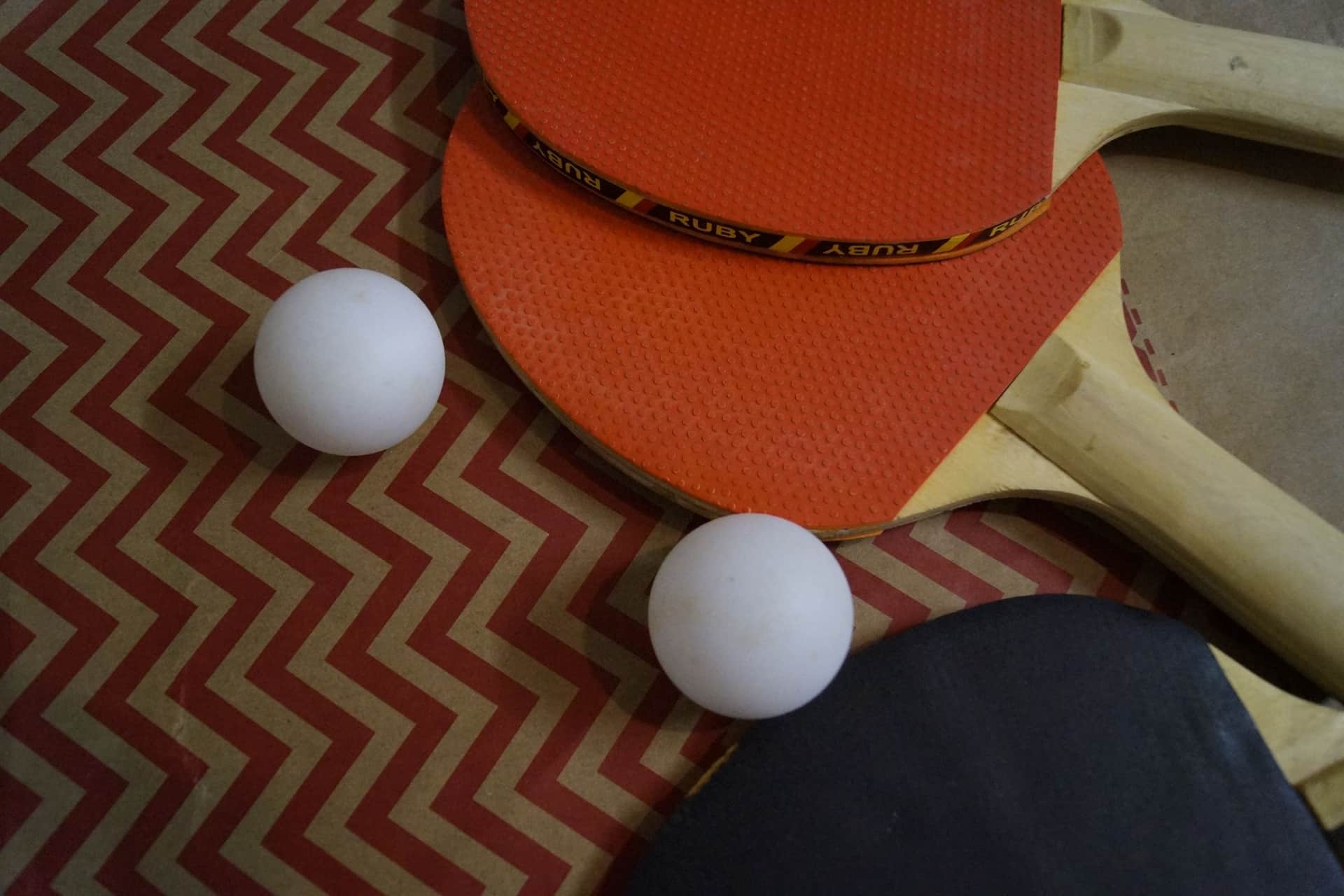
It is worth understanding the mechanism, because it explains why the upgrade feels so dramatic. A table tennis rubber grips the ball for a fraction of a second and that grip is what converts a brushing stroke into spin. Cheap bundled rackets use hard, low-friction rubber over a thin blade — the ball skids rather than grips.
The result is a game with no spin, very little control, and a dead feel off the bat. Players assume the table is the problem, because the table is the expensive thing. It usually is not.
How paddles are described
The three specifications that matter
Paddles are sold with three ratings, usually out of 10: speed, spin and control. They trade off against each other — a faster racket is less controllable, almost by definition.
| Player | Prioritize | Why |
|---|---|---|
| Complete beginner | Control | A fast blade sends the ball long before the technique exists to keep it down |
| Improving / plays weekly | Balanced speed and spin | Enough of both to develop a real game without fighting the racket |
| Attacking player | Spin | Grip on the rubber is what makes topspin work |
| Family and guests | Durability | Grippy competition rubber wears fast and is wasted on casual play |
The other thing you will see is the handle shape — flared, straight or anatomic. It is a genuine preference and not a performance ranking. Flared is the most common and suits most people; if in doubt for a gift, buy flared.
Quick picks
Tap any row to jump to the full write-up.
| # | Product | Best for | Price |
|---|---|---|---|
| 1 | Best all-round paddle STIGA Pro Carbon Table Tennis Racket The default recommendation for someone who has decided they play. | An improving player who wants one good racket | Check price on Amazon |
| 2 | Best for beginners STIGA Evolution Table Tennis Racket Control-oriented, so the ball stays on the table while you learn. | Somebody genuinely starting out | Check price on Amazon |
| 3 | Best for spin JOOLA Infinity Overdrive Racket For the player who has started attacking and wants the ball to bite. | Confident players who loop and drive | Check price on Amazon |
| 4 | Best family set STIGA 4-Player Table Tennis Set Four usable paddles so nobody is stuck with the bad one. | Any table played by more than two people | Check price on Amazon |
| 5 | Best budget upgrade Killerspin JET200 Table Tennis Paddle The cheapest paddle that is a genuine step up from a bundled one. | Replacing table-bundled rackets without much outlay | Check price on Amazon |
#ad · Buy links are affiliate links and we earn a commission on qualifying purchases. Photographs are licensed images of the category, not of the individual unit — see each retailer listing for the product’s own photography.
1. Best all-round paddle
STIGA Pro Carbon Table Tennis Racket
STIGA
The Pro Carbon is the paddle that gets recommended more than any other for a reason: it sits exactly where a home player's needs are. A carbon layer in the blade adds speed and stiffness, and the rubber has enough grip to put real spin on the ball without being so fast that a developing player cannot control it.
The jump from a bundled paddle is dramatic and immediate. Bundled rackets have hard, low-friction rubber that the ball skids off; a proper paddle grips the ball, which is what makes spin and control possible at all. Most people describe it as the table suddenly playing better.
It is more paddle than a purely casual player needs, and that is the only caveat. If someone plays weekly, this is the one to buy.
What we like
- Carbon-layered blade for speed and stiffness
- Grippy rubber that generates real spin
- The standard recommendation at this level for good reason
- STIGA is a genuine table tennis manufacturer
Worth knowing
- Faster than a complete beginner needs
- Rubber wears and eventually needs replacing
- More expensive than a family set
Who it’s wrong for
A total beginner or a young child. The speed works against them — start with a control-oriented paddle instead.
#ad · We earn a commission on qualifying purchases. How this is funded
2. Best for beginners
STIGA Evolution Table Tennis Racket
STIGA
Beginners are usually better served by a slower, more controlled paddle than by a fast one. A fast blade sends the ball long before the technique exists to keep it down, which is frustrating and teaches bad habits.
This is the sensible entry point into real paddles: enough grip on the rubber to feel spin and start learning what it does, without the speed that makes a beginner's game unplayable.
It is also the paddle we would buy for a teenager who is getting interested — it grows with them for a season or two before a faster racket makes sense.
What we like
- Control-focused, which is what beginners actually need
- Still grippy enough to learn spin on
- Cheaper than performance paddles
- Comfortable handle for smaller hands
Worth knowing
- An improving player will outgrow it
- Slower on attacking shots
- Not a competition racket
Who it’s wrong for
A player who already has technique. They will find it slow and want more from the blade.
#ad · We earn a commission on qualifying purchases. How this is funded
3. Best for spin
JOOLA Infinity Overdrive Racket
JOOLA
Once someone is attacking rather than rallying, the rubber becomes the limiting factor. Tacky, high-grip rubber on a stiff blade is what lets a player brush the ball and generate the heavy topspin that makes an attacking game work.
This is a step past a family paddle and it behaves like it — it is unforgiving if your technique is loose. For the right player it is exactly the right upgrade.
Bear in mind that competition-grade rubber wears faster than the harder rubber on casual paddles, and loses grip as it does. That is a normal cost of the category rather than a fault.
What we like
- High-grip rubber for heavy topspin
- Stiff blade that rewards clean contact
- A real performance upgrade for an attacking player
- JOOLA build quality
Worth knowing
- Unforgiving of poor technique
- Rubber wears faster and loses tack
- Too much racket for casual play
Who it’s wrong for
Casual family play. It will make the game harder, not better, for someone rallying gently.
#ad · We earn a commission on qualifying purchases. How this is funded
4. Best family set
STIGA 4-Player Table Tennis Set
STIGA
A table needs enough paddles for doubles and for guests. Four matched rackets at once is far better value than four individual paddles, and it means nobody ends up with the warped one from the box.
These are family paddles, not performance rackets — the point is that everyone has something decent in their hand. Pair the set with one good paddle for the person who actually plays and the table is properly equipped.
What we like
- Four matched paddles plus balls in one purchase
- Much better than the rackets bundled with tables
- Enough for doubles
- Inexpensive
Worth knowing
- Not performance rackets
- Rubber is durable rather than grippy
- A serious player will want their own
Who it’s wrong for
Someone buying a single racket for themselves. Buy one good paddle instead of four adequate ones.
#ad · We earn a commission on qualifying purchases. How this is funded
5. Best budget upgrade
Killerspin JET200 Table Tennis Paddle
Killerspin
If the goal is simply to stop playing with the rackets that came in the box, this is the least you need to spend to achieve it. A real blade, real rubber, a handle that is not an afterthought.
It will not satisfy an improving player for long, but as the difference between “this table is disappointing” and “this table is fun”, it is the best few dollars in the category.
What we like
- A real paddle at a very low price
- Immediate improvement over bundled rackets
- Cheap enough to buy several
- Durable enough for family use
Worth knowing
- Basic rubber
- Outgrown quickly by anyone improving
- Limited spin potential
Who it’s wrong for
A regular player. Buy once at the mid tier rather than twice at this one.
#ad · We earn a commission on qualifying purchases. How this is funded
Care
Looking after a paddle
- Keep it in a case. Dust and grit kill rubber grip faster than play does.
- Wipe the rubber with a damp cloth after sessions. It restores a surprising amount of tack.
- Keep it out of sunlight and heat. Rubber hardens and goes glassy, and once it has, no cleaning brings it back.
- Replace the rubber when it stops gripping. On a good blade this is a cheap refresh rather than a new racket — on a bundled paddle it is not worth doing.
Questions
Common questions
What is the best ping pong paddle for a beginner?
Are expensive ping pong paddles worth it?
What paddle is best for spin?
How often should you replace ping pong rubber?
Sources
Keep reading
Read next