Roundup
Best foosball tables for athletes
An athlete does not need a different game, they need a table that does not move. Cabinet mass, rod tolerance and bearings are what separate a table that survives hard play from one that loosens inside a season.
By Ryder M. · Last updated November 10, 2026 · How we pick
Cue & Paddle is reader-funded. If you buy through a link on this page we may earn a commission, at no extra cost to you. It never changes which products we pick or how we rank them — read the full disclosure.
The verdict: the Tornado Tournament 3000 is the table for a genuinely competitive player - Tornado is one of the five official ITSF table brands, and the Tournament 3000 is built so cabinet flex never shifts the rod alignment during a long session. The budget pick is the Hathaway Braxton 55 in, the cheapest table here that is both genuinely full size and solid enough for adult play. If the table has to live in a family room rather than a team room, the Hathaway Primo 56 in has the cabinet mass that hard play actually demands.
Athletes do not need a special foosball table. What they need is a table whose specifications do not change while they are using it - and that is a genuinely different requirement from what most home tables are built for. Hard play is a load case, and the components that fail under it are the cabinet, the bearings and the rods, in that order.
The load case
What hard play actually breaks
The cabinet moves. A light cabinet under two adults playing hard walks across the floor, and when the table moves, the geometry between the rods and the goals changes. Shots that were going in stop going in for reasons that are nothing to do with the player, and the player compensates - which embeds a fault in their technique rather than in the table.
The bearings develop play. Rods run in bearings set into the cabinet walls, and every shot loads them. Cheap bearings loosen, the rods start to rattle, and shot placement becomes imprecise. The reason this goes undiagnosed is that it feels exactly like losing form - gradual, and specific to the shots you take most.
The rods flex or bend. Hollow rods under hard shooting flex during the stroke, which means the man arrives at a slightly different angle each time. Solid rods do not. This is why competition tables use solid rods even though they are slower to move.
The playfield wears in the traffic areas. Once the surface is uneven the ball no longer runs predictably, and a playfield is not a home repair. This is a slow failure and the one that eventually retires a table.
Criteria first
What decides a table for hard play
1. Cabinet mass. First, by a wide margin. If two tables are otherwise similar, buy the heavier one - it is the cheapest route to a table whose geometry holds.
2. Bearings, and whether they are replaceable. The component that decides how long the table stays precise. Replaceable bearings turn a wear-out into a service item.
3. Solid rods over hollow. Rigidity makes shots repeatable, which is what a competitive player is actually buying. The weight penalty is real and most serious players accept it.
4. Full playfield length, non-negotiable. Full size starts at about 54 inches, and technique developed on a shorter table does not transfer because the passing distances change the timing. For anyone training, this comes before everything except mass.
5. Playing tradition - American or European. Not a quality axis. American tables favour pinning and controlled shooting with heavier men; European tables favour the faster passing game. Buy the one you learned on.
6. ITSF brand lineage, if you compete. As of 2019 the ITSF's five official table brands were Bonzini, Roberto Sport, Garlando, Tornado and Leonhart, with others including Warrior and Fireball recognised for international and professional tournaments. Practising on the equipment the sport uses is worth real money if you enter events.
The numbers
Specification against how hard you play
| How you play | Cabinet | Rods | Bearings |
|---|---|---|---|
| Socially, a few times a month | Any full-size cabinet | Hollow is fine | Basic |
| Regularly and hard, at home | Heavy home cabinet | Solid preferred | Mid-grade, replaceable |
| Daily practice | Competition mass | Solid | Competition-grade |
| Entering ITSF-rules events | ITSF-brand table | Solid | Competition-grade |
Full size is about 54 in of playfield and up, and is a prerequisite at every row above the first. Cabinet mass is the cheapest specification that addresses hard play, and the first one to buy.
Quick picks
Tap any row to jump to the full write-up.
| # | Product | Best for | Price |
|---|---|---|---|
| 1 | 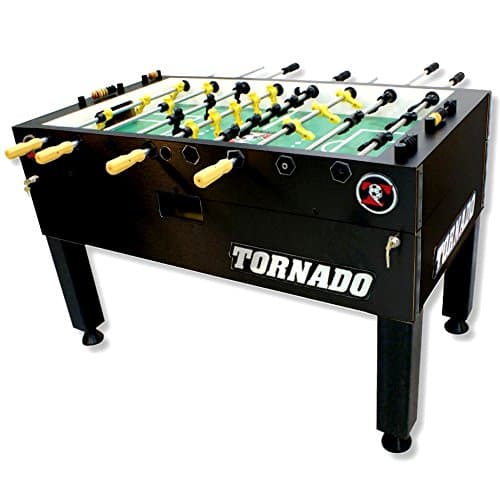 Best for competitive play Tornado Tournament 3000 Foosball Table An ITSF-brand tournament table built for continuous hard play. | A player who competes, or a team room that gets used daily | $3,295.00View on Amazon |
| 2 | 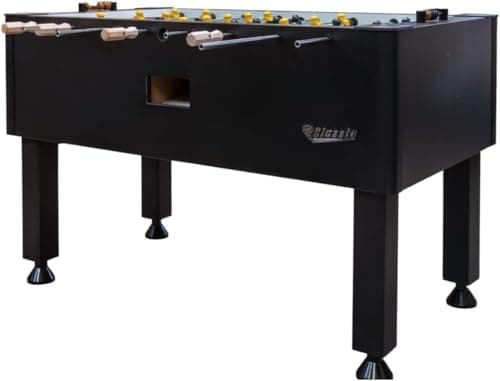 Best American-style competition table Tornado Classic II Foosball Table The same brand's home-market tournament table, with the heavier pinning game. | A player who learned on American bar tables and wants that feel at home | $2,395.00View on Amazon |
| 3 | 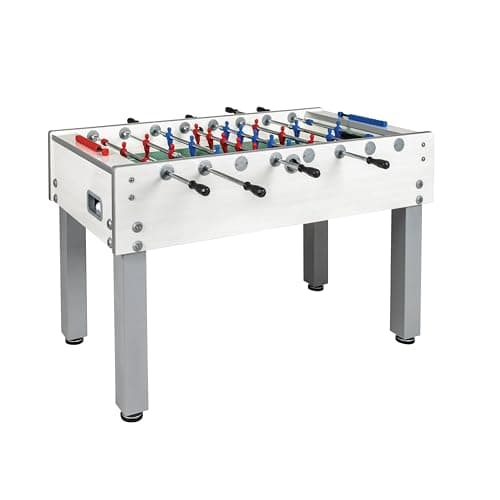 Best European competition table Garlando G-500 Foosball Table An ITSF-brand European table, for the faster passing game. | A player who competes in the European style, or wants to learn it | $2,099.99View on Amazon |
| 4 | 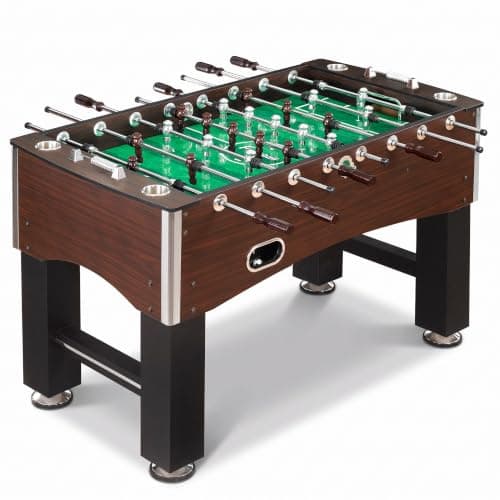 Best home table for hard play Hathaway Primo 56 in Foosball Table A 56 in home table with enough cabinet mass to take a genuinely hard game. | An athletic player whose table lives in a family room rather than a team room | $614.02View on Amazon |
| 5 | 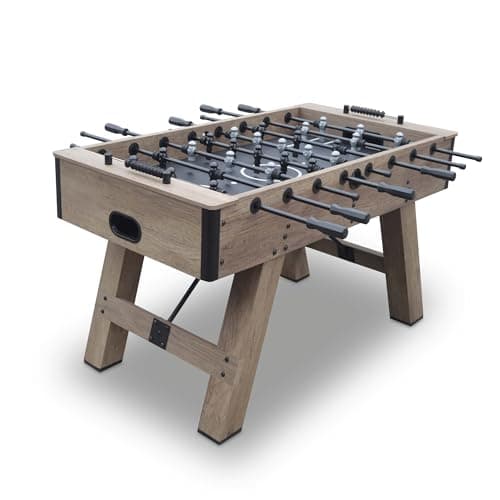 Budget pick Hathaway Braxton 55 in Foosball Table The cheapest table here that is still full size with a cabinet worth playing on. | A competitive player on a limited budget who needs full size above all | $425.59View on Amazon |
#ad · Buy links are affiliate links and we earn a commission on qualifying purchases. Prices and product photographs come from the Amazon listing itself and are refreshed daily; the date they were last checked is shown under each buy button. Where a maker does not sell through Amazon there is no product photo, and the card below says so.
1. Best for competitive play
Tornado Tournament 3000 Foosball Table
Tornado
If the table is going to be played on hard and often, this is the specification that is actually designed for it. Tornado is one of the five official ITSF table brands - as of 2019 the International Table Soccer Federation's official list was Bonzini, Roberto Sport, Garlando, Tornado and Leonhart - and the Tournament 3000 is its competition table.
What a tournament table is built around is tolerance under load. Rods run in bearings mounted in the cabinet walls, and hard play puts both lateral and torsional force through that assembly continuously. A competition table's cabinet does not flex, so the bearing alignment holds, which means the rods stay true and shots stay repeatable through a long session.
The practical consequence for an athletic player is that the table does not change during a game. Cheaper tables loosen as they are played on - subtly, over an evening, and permanently over a season - and the player experiences that as their own form deteriorating. A table at this level removes that variable entirely.
What we like
- Tornado is one of the five official ITSF table brands
- Cabinet mass sufficient that rod alignment does not shift under load
- Bearings and rods specified for continuous play, not occasional play
- Repeatable shot geometry through a long session
Worth knowing
- The most expensive table here
- Effectively a permanent installation - not something you reposition
- Overspecified for a household that plays socially
Who it’s wrong for
A family room with children. The technique a tournament table rewards is not the technique children use, and the money is better spent on a heavier home table.
#ad · We earn a commission on qualifying purchases. How this is funded · Price as of November 10, 2026
2. Best American-style competition table
Tornado Classic II Foosball Table
Tornado
American-style foosball is built around pinning and controlled shooting rather than the faster European passing game, and the equipment reflects it: heavier men, a different playfield finish, and a game where the ball is held and worked rather than moved quickly.
That style puts a different load through the table. Pinning holds the ball under a man and loads the rod statically, then releases it hard, and the bearings take that cycle thousands of times. The Tornado Classic II is specified for it - solid rods and substantial cabinet mass - which is why it is the right table for a player with an American reference point.
Which tradition suits you is not a quality question, it is a question of what you learned on. A European passing player on an American table will find the men heavy and the playfield slow; an American player on a European table will find the ball runs away from them. Tornado vs Warrior covers the American side in detail.
What we like
- ITSF-recognised brand, in the American playing tradition
- Solid rods and heavy cabinet, specified for pinning loads
- Substantially cheaper than the Tournament 3000
- The right table for an American-trained player
Worth knowing
- The American style is a preference, not an upgrade
- Still a permanent installation
- Heavy men feel slow to a European passing player
Who it’s wrong for
A player trained on European tables. The ball behaviour and the men are different enough that it will feel wrong rather than better.
#ad · We earn a commission on qualifying purchases. How this is funded · Price as of November 10, 2026
3. Best European competition table
Garlando G-500 Foosball Table
Garlando
Garlando is the European entry on the ITSF's official brand list, and the G-500 is its home-market table. The European tradition is a faster game: lighter men, a quicker playfield, and an emphasis on the two-bar to five-bar to three-bar passing sequence rather than on pinning.
For an athletic player that style is more demanding in a different way - it rewards reaction speed and precise rod control over static strength, and it punishes a slow five-bar. The table is specified accordingly: rods that run freely, a playfield finished for predictable ball roll, and bearings sized for high rod-movement volume rather than high static load.
It is also the table most consistent with how the sport is governed. The ITSF standardised the rules after its establishment in France in 2002, and the no-spin rule - no full 360-degree rod rotation before or after hitting the ball - shapes the technique a European table is built to reward.
What we like
- Garlando is one of the five official ITSF table brands
- European specification: faster playfield and freer rods
- Bearings sized for high rod-movement volume
- The right practice equipment for European-rules competition
Worth knowing
- Expensive relative to any home table
- Fast playfield is unforgiving for a beginner
- Permanent once sited
Who it’s wrong for
A casual household. A fast European table makes a social game harder rather than better, and the cost is substantial.
#ad · We earn a commission on qualifying purchases. How this is funded · Price as of November 10, 2026
4. Best home table for hard play
Hathaway Primo 56 in Foosball Table
Hathaway
Not every competitive player wants a tournament table in the house, and this is the pick for that case. At 56 inches the Hathaway Primo is comfortably full size, and the specification that earns it a place here is mass: the cabinet is heavy enough that two adults playing hard do not move it.
That is the first thing athletic play exposes. A light full-size table walks across the floor under lateral load, and once it moves the rod alignment relative to the goals has changed - so shots that were going in stop going in, for reasons that have nothing to do with the player. Mass fixes that, and mass is cheaper than competition lineage.
Where it falls short of the tables above is rod tolerance and bearing life under daily use. For a player who competes occasionally and plays at home regularly, that is the correct trade. For one who practises daily, the bearings become the limit within a year or two.
What we like
- 56 in full-size playfield with real cabinet mass
- Stays put under hard adult play, which is the first thing athletes need
- Far cheaper than any ITSF-brand table
- Suitable for a family room rather than a dedicated team room
Worth knowing
- Home-specification rods and bearings
- Bearings develop play under daily practice
- Not competition-tolerance equipment
Who it’s wrong for
Daily practice toward competition. The bearings are the limiting component and daily use finds them quickly.
#ad · We earn a commission on qualifying purchases. How this is funded · Price as of November 10, 2026
5. Budget pick
Hathaway Braxton 55 in Foosball Table
Hathaway
This is the budget pick, and its claim is specific: it is the least expensive table on this page that is both genuinely full size and solid enough to take adult play. At 55 inches the playfield is functionally the same as the Primo above, with the savings taken in the cabinet finish and the hardware.
For an athletic player with a budget, playfield length is the thing not to compromise. Technique developed on a 48 in table does not transfer cleanly to full size, because the passing distances and therefore the timing are different. Full size on a basic cabinet beats a nice 48 in table for anyone who intends to play properly.
What you accept is bearing life. Cheaper bearings develop play sooner, and play reads as your own form slipping - so check the rods for rattle periodically rather than assuming it is you. Replacing bearings, where the table allows it, restores most of the feel.
What we like
- 55 in playfield - full size, which is the thing not to compromise
- Cabinet solid enough for adult play with pads under the feet
- The cheapest full-size table on this page by a clear margin
- Same maker as the Primo, so parts align
Worth knowing
- Bearings develop play sooner than on the picks above
- Lighter cabinet, so it needs non-slip pads
- Plainer finish
Who it’s wrong for
A player who practises for competition daily. At that volume this is a one-season table rather than a long-term one.
#ad · We earn a commission on qualifying purchases. How this is funded · Price as of November 10, 2026
Worth knowing
Technique the table rewards
- No spinning. Under ITSF rules a full 360-degree rod rotation before or after hitting the ball is forbidden, with the exception that a spin putting the ball backwards into your own goal stands as an own goal. Rules aside, spinning bends rods and cracks men.
- Wrist strokes, not arm swings. Controlled rod movement from the wrist is what a tournament table's rod tolerance is built to reward, and it is faster than a full-arm motion anyway.
- Pinning, on an American table. Holding the ball under a man to set up a shot is the core of the American game and it loads the rods statically - which is why American tables are specified heavier.
- The five-bar pass, on a European table. The faster European game lives or dies on getting the ball through the opponent's five-bar, which is why European tables are finished for a quick, predictable roll.
- Level the table before blaming yourself. The ball rolls free between touches, so a table that is slightly downhill is persistently unfair. Check it with a level, not by eye.
- Clean the playfield and the men. Dust and hand oil change how the ball runs. How to clean a foosball table covers the routine.
The verdict
Which to buy
- Competition, seriously - Tornado Tournament 3000. ITSF brand, built so nothing shifts under load.
- American style - Tornado Classic II. Solid rods and the mass a pinning game demands.
- European style - Garlando G-500. ITSF brand, fast playfield, freer rods.
- Hard play in a family room - Hathaway Primo 56 in. The mass that matters, without competition pricing.
- Full size on a budget - Hathaway Braxton 55 in. The playfield length not compromised, the hardware is.
Prices on competition tables move with freight and import rather than season, so this page compares positions rather than figures and leaves the number to the live listing on each pick. For the competition tier specifically, best competition foosball tables goes deeper, and best foosball tables for adults covers the step below if the goal is hard social play rather than training.
Questions
Common questions
What makes a foosball table good for athletes?
Which foosball tables do competitions use?
Are solid rods necessary for competitive play?
American or European foosball table?
Why have my shots stopped going in on my own table?
Is a cheap full size table better than a good 48 inch one?
Sources
Keep reading
Read next