Guide
How to clean a foosball table
A sticky table is almost always dirty rods rather than a worn table, and the fix takes fifteen minutes. The wrong lubricant makes it permanently worse.
By Ryder M. · Last updated October 17, 2026 · How we pick
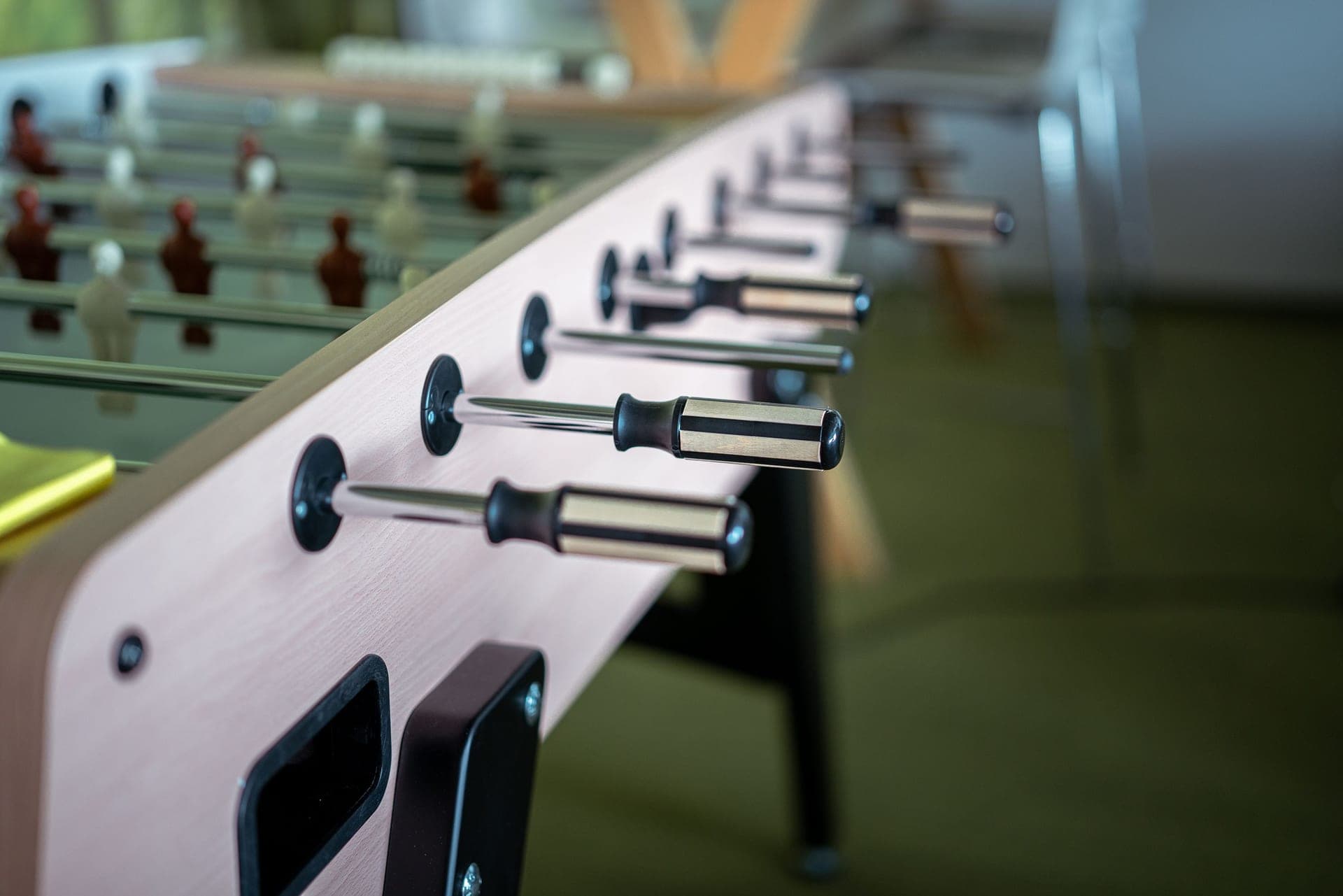
The short answer: wipe the playfield with 70 percent isopropyl alcohol on a lint-free microfiber cloth, clean the rods dry with a cloth to lift grime, and then lubricate with one or two drops of 100 percent liquid silicone at each bearing, spread along the rod with a cloth. Never use WD-40 or any petroleum-based spray — it degrades nylon components and attracts dust into the bearings, which makes the table permanently worse rather than better.
Foosball is the game-room table where maintenance has the most obvious effect, because the thing that gets dirty is the thing you hold. A table that feels sticky, slow or notchy almost always has grime on the rods and dust in the bearings, and both come back to new in a quarter of an hour. The long-term enemy is the wrong lubricant, which is why half this page is about what not to put on it.
Fifteen minutes
The routine
- Take the balls off and check the goals. Balls collect grime and then transfer it to the playfield on every shot. Wipe or replace them; they are cheap and they are the dirtiest thing on the table.
- Dry-dust the playfield first. A dry microfiber cloth lifts grit before you add any liquid. Rubbing grit into a printed playfield with a damp cloth is how a field goes dull.
- Wipe the playfield with 70 percent isopropyl alcohol on a lint-free cloth. Alcohol lifts hand oils and evaporates rather than sitting on the surface, which matters because most playfields are a printed or laminated layer over MDF and standing water finds the edges.
- Clean the rods dry. Slide each rod to one side and wipe the exposed length with a dry cloth, then slide it the other way and do the rest. This is the step that fixes a sticky table, and it needs no liquid at all.
- Wipe the men and the rod ends. The men shed plastic debris onto the field, and the rod ends collect whatever is on people's hands.
- Lubricate with 100 percent silicone. One or two drops at each bearing, then slide the rod back and forth and spread the excess along its length with a cloth. More is not better — excess silicone attracts dust.
- Wipe off the excess. A rod that feels greasy has too much on it, and greasy rods pick up grime faster than dry ones.
- Check the cabinet bolts. While you are there, run a spanner round the cabinet bolts. Loose cabinets are what end family tables, and a quarter-turn a year prevents it.
Manufacturers generally suggest this cycle every 20 to 30 hours of play, which for a household table is somewhere between quarterly and twice a year. A table in an office or a bar wants it monthly.
Products
What to use, and what ruins a table
| Product | Use on | Verdict |
|---|---|---|
| 100% liquid silicone | Rods and bearings | Correct. The only lubricant to use |
| 70% isopropyl alcohol | Playfield, men, rod ends | Correct. Lifts oils and evaporates |
| Dry microfiber cloth | Everything | Correct. Half the job needs nothing else |
| WD-40 and similar sprays | Nothing | Never. Degrades nylon and attracts dust |
| Household oil / 3-in-1 | Nothing | Never. Gums up and collects grit |
| Furniture polish or wax | Nothing | Never. Leaves a film that holds dirt |
| Water | Sparingly, if at all | Avoid. MDF swells where it finds an edge |
| Abrasive cleaners | Nothing | Never. Scours a printed playfield permanently |
Silicone spray in an aerosol is not the same as 100 percent liquid silicone — many sprays carry a petroleum distillate as the propellant and carrier. Read the label.
The WD-40 rule is the important one because the damage is not immediately obvious. A petroleum spray makes the rods feel better for a week, then the residue collects dust into a paste inside the bearings and begins to degrade the nylon bushings and bearing housings. Three months later the table is notchy in a way no amount of cleaning will fix, and the owner concludes the table was cheap.
Quick picks
Tap any row to jump to the full write-up.
| # | Product | Best for | Price |
|---|---|---|---|
| 1 |  Easiest table to maintain Warrior Professional Foosball Table A quick-change bearing system that makes the annual service trivial. | Anyone who wants maintenance to stay a fifteen-minute job | Check price on Amazon |
| 2 | 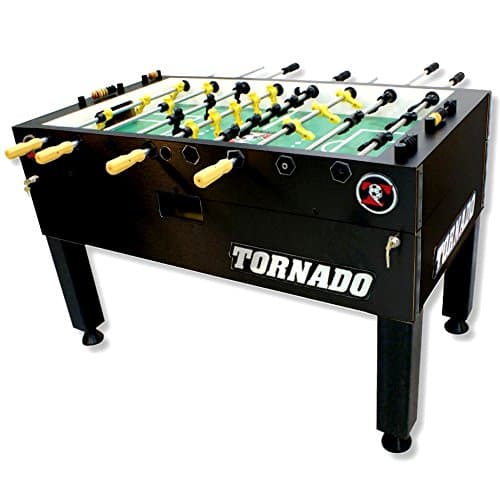 Best rods to keep clean Tornado Tournament 3000 Foosball Table Hollow chrome rods and competition bearings — nothing to degrade. | A dedicated game room table serviced once a year | $3,295.00View on Amazon |
| 3 | 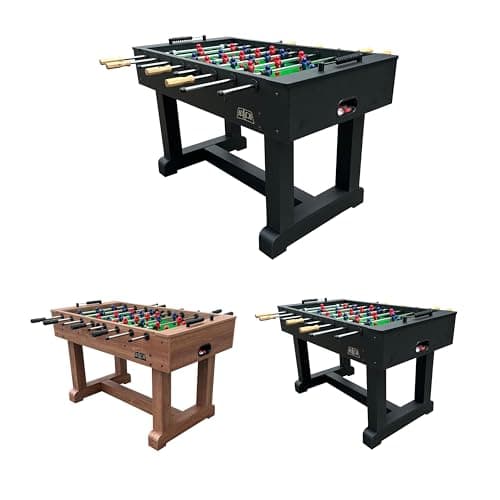 Best family table to maintain KICK Brigade 55 in Foosball Table Real bearings at a family price — the difference maintenance actually makes. | A household table that should still be smooth in five years | Check price on Amazon |
#ad · Buy links are affiliate links and we earn a commission on qualifying purchases. Prices and product photographs come from the Amazon listing itself and are refreshed daily; the date they were last checked is shown under each buy button. Where a maker does not sell through Amazon there is no product photo, and the card below says so.
1. Easiest table to maintain
Warrior Professional Foosball Table
Warrior Table Soccer
Maintenance difficulty on a foosball table is almost entirely about the bearings. On a table where the bearings are pressed in, cleaning them properly means a stripdown; on a table designed around quick-change bearings, you pop them out, clean them, and put them back.
The Warrior Professional is built that way, which matters more over ten years than any playfield specification. Bearings are the component that collects dust and old lubricant, and a table whose bearings can be serviced in minutes is a table whose rods still spin freely in a decade.
The rods ship pre-assembled too, which is relevant here: a table you can take apart and reassemble confidently is a table you will actually service rather than put up with.
What we like
- Quick-change bearings — service in minutes, not hours
- Rods ship assembled and come apart cleanly
- Chrome-plated steel rods that clean up properly
- Counterbalanced men that do not need constant adjustment
Worth knowing
- A serious purchase, not a family-table price
- MDF cabinet with laminate panels
- Single-goalie playfield is a relearn for some players
Who it’s wrong for
A household that just wants a table to play on. This is a competition table that happens to be easy to service.
#ad · We earn a commission on qualifying purchases. How this is funded
2. Best rods to keep clean
Tornado Tournament 3000 Foosball Table
Tornado
Chrome steel rods are the surface that cleans best, because chrome does not hold the oxidised film that dulls cheaper plating and makes rods feel sticky. On a Tornado the rods are hollow chrome steel in thin-wall split competition bearings, which is about as maintenance-indifferent as the mechanism gets.
The practical effect is that the annual service is genuinely annual rather than a recurring irritation. Wipe the rods, a drop of silicone at each bearing, done.
It is also the table where a wrong lubricant does the most damage, because the bearings are precision parts. Petroleum-based sprays attract dust into exactly the place you least want it.
What we like
- Hollow chrome steel rods that stay smooth
- Thin-wall split competition bearings
- Nothing in the mechanism that degrades with age
- Annual service is genuinely a fifteen-minute job
Worth knowing
- Roughly 355 lb — effectively a permanent installation
- The most expensive table in the category
- Serious overkill for social play
Who it’s wrong for
A shared family room or anywhere the table might move. See best foosball tables for families.
#ad · We earn a commission on qualifying purchases. How this is funded · Price as of November 9, 2026
3. Best family table to maintain
KICK Brigade 55 in Foosball Table
KICK
The single component that decides whether maintenance works on a family table is whether it has bearings or nylon bushings. Bushings wear, and once they are worn no amount of cleaning or lubricant restores a smooth rod — the play is mechanical and permanent.
The KICK Brigade uses real bearings in a 55-inch family table, which means the maintenance routine on this page actually keeps it feeling new. On a bushing table the same routine delays the inevitable by a year or two.
If you are reading this page because a cheap table has gone sticky and will not come back, that is the diagnosis. Cleaning a worn bushing does not fix a worn bushing.
What we like
- Real bearings, so cleaning and lubricating genuinely restores feel
- Full 55 in cabinet at a family price
- Braced cabinet that holds its square under heavy use
- Heavy enough to stay put
Worth knowing
- More than a big-box table costs
- Not competition precision
- Two-person assembly
Who it’s wrong for
Someone who wants a table for a few months. Any table works for that.
#ad · We earn a commission on qualifying purchases. How this is funded
Diagnosis
Fixing specific complaints
Rods feel sticky or notchy. Grime on the rods, nine times out of ten. Clean them dry first, before adding any lubricant — adding silicone to a dirty rod just makes a lubricated dirty rod. If cleaning and a light silicone application does not fix it, the bearings or bushings are worn.
The ball does not roll true. Dust and debris in the playfield texture, or a playfield that has swelled. Clean it with alcohol; if the ball still drifts, check the table is level — the levellers at the feet are there for exactly this.
The ball sticks in one spot. Almost always a worn or scratched patch on the playfield, or debris in the ball return. Both are visible if you look along the field at eye level with a light behind you.
Men spin freely and will not hold position. The set screws in the men have loosened, which happens and is a two-minute fix with the correct hex key. On tables with counterbalanced men this shows up as men that no longer stand upright between shots.
The table rocks. Not a cleaning problem. Check the levellers and the cabinet bolts, in that order.
Honest limits
What cleaning will not fix
Worn nylon bushings. On cheap tables the rods run in nylon bushings rather than bearings, and worn bushings mean mechanical play that cleaning cannot touch. This is the main reason a big-box table feels tired after two years and the main argument for buying a table with real bearings.
A swelled playfield. MDF that has taken up moisture domes, and a domed field makes the ball drift. It cannot be flattened. Keeping the table out of damp rooms is the only prevention.
A loose cabinet. Re-tightening the bolts restores a lot. A cabinet whose panel joints have actually worn out is finished, and that is what a decade of a light table looks like. Are foosball tables worth it covers which price band survives.
Bent rods. A bent rod is a replacement rod. On tables from established brands, rods are available as spares, which is one of the quiet advantages of buying a brand over a big-box table.
Questions
Common questions
How do you clean a foosball table?
What lubricant should I use on foosball rods?
Can you use WD-40 on a foosball table?
How often should a foosball table be cleaned?
Why is my foosball table sticky?
Can you use water to clean a foosball playfield?
Sources
Keep reading
Read next