Guide
Dartboard surrounds
A surround is the cheapest insurance in the game room, and the one most people buy a size too small. Here is what it protects, how much wall it has to cover, and when a cabinet does the job better.
By Ryder M. · Last updated October 17, 2026 · How we pick
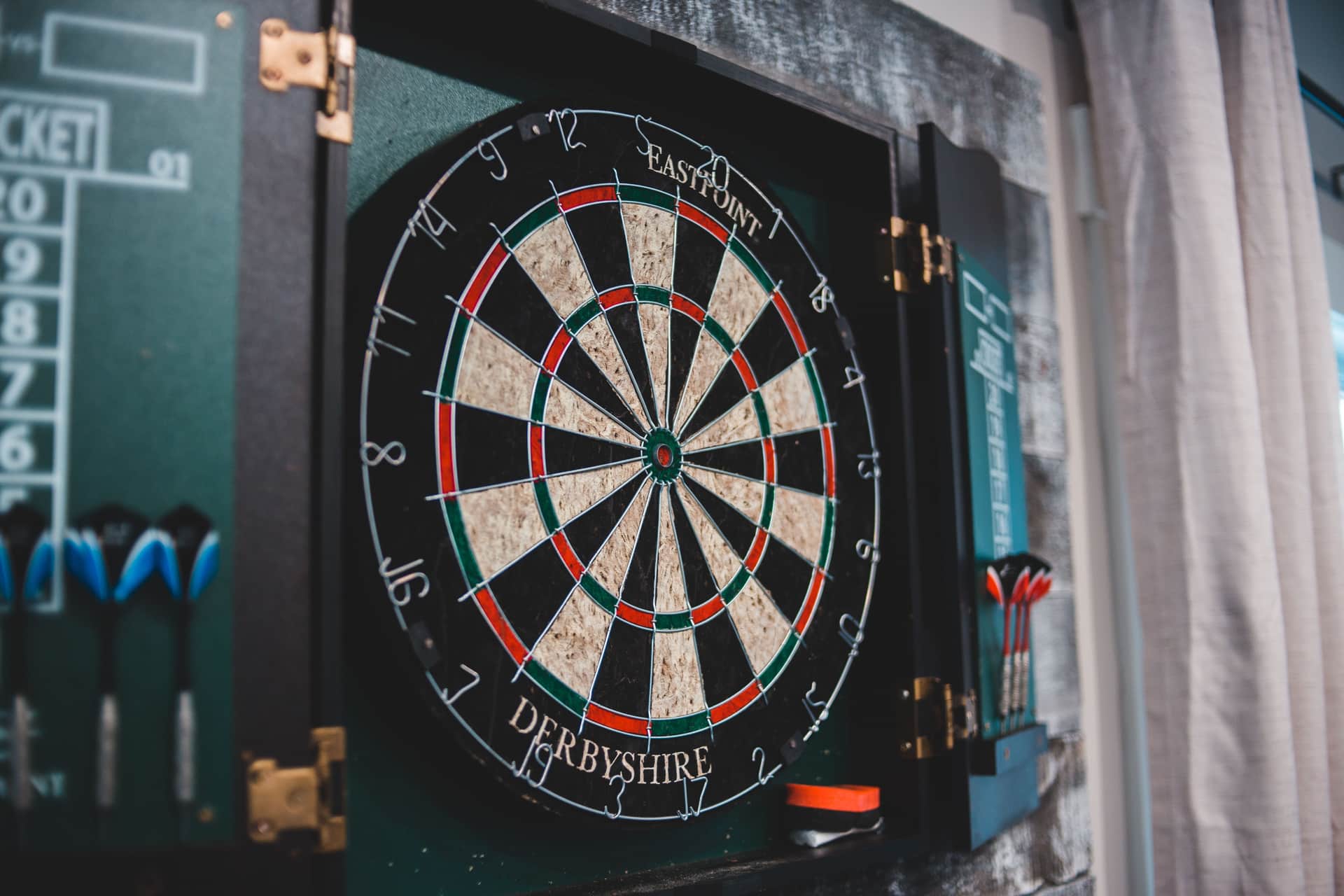
The short answer: yes, if the board is on a wall you would mind repairing, and the surround needs to cover at least 10-12 inches of wall beyond the edge of the board to be worth having. A one-piece foam surround is the best protection per dollar in the game room. A cabinet protects less of the wall above the board but covers the lateral misses and closes flat, which matters more in a room that is not a dedicated game room.
Steel-tip darts are small and heavy and travel at the wall rather than at the floor. A regulation board is only 17.75 in across, so the area around it takes a surprising amount of traffic — not from bad players, but from everybody, because a dart that deflects off a wire goes somewhere unplanned. A dart in plaster is a hole you fill; a dart in trim or wallpaper is worse.
The product
What a surround actually is
A dartboard surround is a ring of dense closed-cell foam — usually EVA — that fits around the outside of the board and sits flush with its face. Darts that miss the sisal land in the foam, which closes over the hole rather than keeping it. It is one of the few game-room accessories where the cheap version and the expensive version do the same job: foam either absorbs a dart or it does not.
Surrounds come in one piece or in four or six interlocking sections. Sections pack smaller and ship cheaper, and they are the ones that fail. The seams open up with temperature and handling, and a dart that lands in an open seam passes straight through to the wall. If you have the choice, buy one piece.
The number that matters
How much wall it has to cover
This is where most surround purchases go wrong. A surround that extends 6 inches past the board looks adequate and catches almost nothing useful, because the darts you need to catch are the ones that deflect off the outer wire and travel outward. Aim for a surround that gives you at least 10-12 inches of protected wall in every direction from the edge of the board — an overall diameter of around 38-42 in against the board's 17.75 in.
| Option | Protects above the board | Protects beside the board | Closes? |
|---|---|---|---|
| One-piece foam surround | Yes, full radius | Yes, full radius | No |
| Sectional foam surround | Yes, until the seams open | Yes, until the seams open | No |
| Slim cabinet | Carcass only — a few inches | Door width each side | Yes |
| Wide pub-style cabinet | Carcass only — a few inches | Wide door each side | Yes |
| Cabinet plus surround inside it | Yes, full radius | Door width plus surround | Yes |
| Nothing | No | No | n/a |
The last row is in the table on purpose: on a garage block wall or an unfinished basement wall, no protection is a legitimate choice.
The row worth noticing is the last functional one. A surround fitted inside a cabinet is the belt-and-braces setup, and it is the one serious home setups usually end up at — the surround handles the high misses the cabinet cannot, and the cabinet closes.
Quick picks
Tap any row to jump to the full write-up.
| # | Product | Best for | Price |
|---|---|---|---|
| 1 | 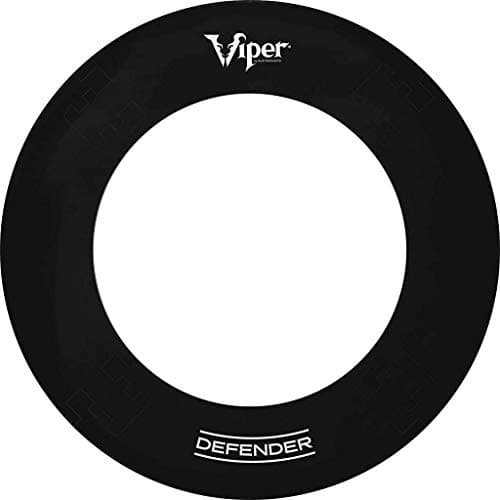 Best dedicated surround Viper Defender Dartboard Surround A one-piece EVA ring that takes the misses a board does not. | A board already mounted on a wall you care about | $36.99View on Amazon |
| 2 | 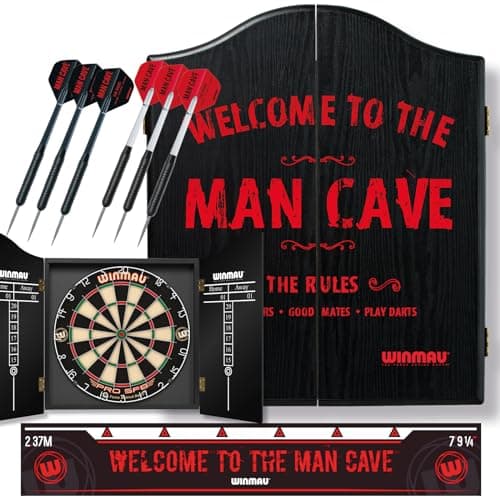 Best cabinet instead of a surround Winmau Man Cave Dartboard Cabinet Set A full cabinet with board and darts, closing flat against the wall. | Rooms that are not dedicated game rooms | $109.95View on Amazon |
| 3 | 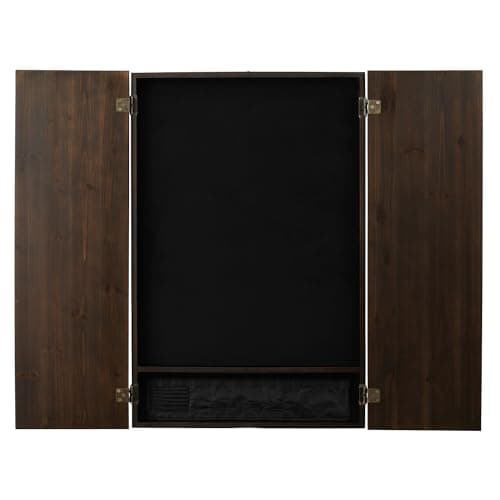 Best cabinet for a tight wall Viper Metropolitan Dartboard Cabinet A slim cabinet that protects the wall without eating the room. | Hallways, narrow basements and walls with furniture nearby | Check price on Amazon |
| 4 | 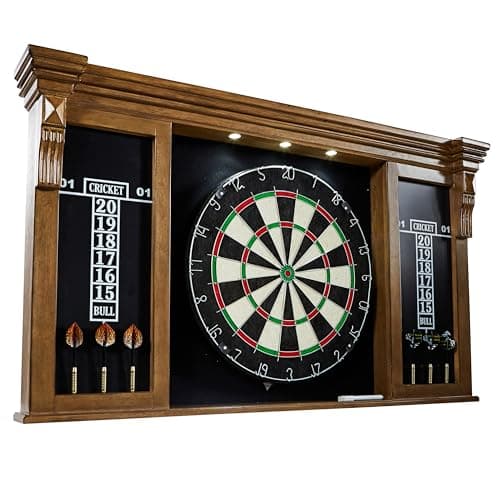 Best protection for a wall you cannot repair Barrington Woodhaven Pub-Style Dartboard Cabinet A deep pub-style cabinet with wide doors and real coverage. | Rented rooms and finished basements | $169.99View on Amazon |
#ad · Buy links are affiliate links and we earn a commission on qualifying purchases. Prices and product photographs come from the Amazon listing itself and are refreshed daily; the date they were last checked is shown under each buy button. Where a maker does not sell through Amazon there is no product photo, and the card below says so.
1. Best dedicated surround
Viper Defender Dartboard Surround
Viper (GLD Products)
A surround is a ring of dense foam that clamps around the outside of the board and absorbs the darts that miss the 451 mm face. The Defender is the straightforward version of that: one piece, self-healing EVA, fitted to a regulation bristle board, in a dark finish that reads as part of the board rather than as an accessory.
The reason to prefer a one-piece surround over a sectional one is simple. Sectional surrounds separate at the seams over time, and a dart that lands in a widening seam goes straight through to the wall behind it. A single moulded ring has nowhere to come apart.
It is also the only option if your board is already up and the geometry is right. Retrofitting a cabinet means remounting the board; a surround goes on in minutes and changes nothing about the height.
What we like
- One piece — no seams to separate and let a dart through
- Self-healing EVA foam closes over holes
- Fits regulation 451 mm bristle boards
- Fits over an already-mounted board with no remounting
Worth knowing
- Protects a limited radius — a wild miss still finds the wall
- Does not close, so the board is always on show
- Dark foam shows chalk dust and scuffs
Who it’s wrong for
A shared living room where the board needs to disappear between games, or a household with a genuinely wild thrower.
#ad · We earn a commission on qualifying purchases. How this is funded · Price as of November 9, 2026
2. Best cabinet instead of a surround
Winmau Man Cave Dartboard Cabinet Set
Winmau
A cabinet solves the same problem as a surround with a different geometry. The open doors stand proud of the wall on both sides of the board, so a dart that misses laterally hits the inside of a door rather than the plaster. Vertically, you get less protection than a surround gives — which is worth knowing, because high misses are common.
What you gain is that the thing closes. In a room that is also a lounge, an office or a dining room, that is the difference between a board that stays up and a board that comes down after a month.
Buying a cabinet as a set also avoids the mounting error that ruins otherwise careful installations, because the board sits in a fixed position inside the cabinet and you hang the whole assembly to one height.
What we like
- Closes flat, so the board can live in a shared room
- Doors protect the lateral misses, which are the common ones
- Supplied as a set with board and darts
- Stores darts, flights and chalk out of sight
Worth knowing
- Less protection above the board than a surround gives
- Needs clearance for the doors to swing
- Heavier to mount — find the studs
Who it’s wrong for
A dedicated game room where nothing needs hiding. A surround covers more of the wall for less money.
#ad · We earn a commission on qualifying purchases. How this is funded · Price as of November 9, 2026
3. Best cabinet for a tight wall
Viper Metropolitan Dartboard Cabinet
Viper (GLD Products)
Not every wall has 18 inches of clear space either side of the board for cabinet doors. The Metropolitan is the narrower-profile answer: a slimmer carcass, doors that swing in a shorter arc, and a footprint that works on a wall where a pub-style cabinet would foul a doorway or a bookcase.
The trade is interior storage. There is less of it, and bulky accessories will not fit. For protecting plaster in a constrained room, that is a trade worth making.
What we like
- Narrow profile for constrained walls
- Doors swing in a shorter arc
- Closes to hide the board completely
- Mounting hardware included
Worth knowing
- Less interior storage than a full-depth cabinet
- Narrower doors protect a narrower band of wall
- Board usually bought separately
Who it’s wrong for
A player who wants maximum wall coverage. Go wider, or go with a surround.
#ad · We earn a commission on qualifying purchases. How this is funded
4. Best protection for a wall you cannot repair
Barrington Woodhaven Pub-Style Dartboard Cabinet
Barrington Billiards
Where a repair is genuinely not an option — a rental, a newly finished basement, a room with a feature wall — the right answer is the widest cabinet the wall will take. A deep pub-style cabinet puts a substantial wooden door on each side of the board and gives you the largest protected area any single product here provides.
It is also the one that most changes the look of the room, which cuts both ways. Some people want the pub-corner effect; others find it dominates. Measure the door swing before ordering, because this is the style most likely to foul something.
What we like
- Widest door coverage of the cabinets here
- Substantial carcass that takes repeated door slams
- Generous interior storage for darts and accessories
- Closes completely
Worth knowing
- Needs the most wall and the most door-swing clearance
- Visually dominant in a small room
- Heaviest to mount of the three
Who it’s wrong for
A small or narrow room. The door swing is the constraint and it is unforgiving.
#ad · We earn a commission on qualifying purchases. How this is funded · Price as of November 9, 2026
How to decide
Surround or cabinet?
- Does the board need to disappear? If the room is also a lounge, an office or a dining room, you want a cabinet. Boards in shared rooms that cannot be hidden come down within a couple of months, and a board in a cupboard gets played on less than a board on a wall.
- How repairable is the wall? Block, brick or unfinished studwork — a surround is a nicety. Plaster, wallpaper, a feature wall or a rental — protection is the point of the purchase, so buy for coverage.
- How much clear wall is there? Cabinet doors need room to swing. Measure from the centre of the board outward in both directions before you buy anything pub-style.
- Who throws? If children or beginners play, misses go higher and wider than you expect. That favours a surround, which protects the full radius, over a cabinet, which does not protect above the board.
- Is the board already up and correct? A surround fits over an existing installation without touching the height. A cabinet means remounting, which means re-checking the 5 ft 8 in to the bull.
- Is it steel tip or soft tip? Soft tips rarely mark plaster, so on an electronic board protection is mostly about tidiness rather than damage. See bristle vs electronic.
Mounting
Fitting it without wrecking the geometry
A surround changes nothing about where the board sits — it clamps around the outside and the board stays at its mounted height. That is its quiet advantage. A cabinet does change the geometry, because the board is fixed inside the carcass, so you hang the cabinet to put the bull at 1.73 m (5 ft 8 in) rather than hanging it where it looks central on the wall.
Get that wrong and every throw on the board is being practised at the wrong height. The full hanging procedure, including the 7 ft 9.25 in throw measurement, is in how to set up a dartboard at home, and the standards themselves are in dartboard height and distance.
Honest limits
What a surround will not fix
Bounce-outs. A surround catches darts that miss the board. It does nothing about darts that hit the board and fall out, which is a wire problem — see best dartboards for no bounce outs.
Noise. Foam deadens the thud of a miss slightly. It does not make darts quiet, and in an apartment that is the complaint that matters. Best dartboards for apartments deals with the noise question directly.
A genuinely wild thrower. Nothing with a 40 in diameter protects a wall from a dart that leaves the lane entirely. If that is the situation, the honest answer is soft tip.
Questions
Common questions
Do I need a dartboard surround?
What size dartboard surround do I need?
Is a cabinet better than a surround?
Can I use a surround inside a cabinet?
Are sectional surrounds as good as one-piece?
Will a surround stop bounce-outs?
Keep reading
Read next