Guide
Dart board size
One number answers most of these searches, and it is 17.75 inches. Here is that number, every other measurement on the board, and the three board sizes that are not regulation at all.
By Ryder M. · Last updated October 17, 2026 · How we pick

The short answer: a regulation dartboard is 451 mm — 17.75 inches — in diameter. That is the World Darts Federation specification for the bristle boards used in steel-tip play, and it is the figure almost every search for dart board size is after. Soft-tip electronic boards use a different standard: a 15.5 in (394 mm) target face. Anything smaller than either is a novelty or a children's board, not a scaled-down regulation board.
Size questions about dartboards split three ways, and they get tangled together constantly. There is the diameter of the board itself, the dimensions of the rings printed on its face, and the measurements for hanging it — height and throwing distance. This page covers the first two. The hanging figures live on dartboard height and distance, and the floor space the whole setup needs is in how much space do you need for a dartboard.
The numbers
The regulation dartboard, measured
Every figure below comes from the World Darts Federation playing and equipment rules. They are published tolerances, not opinions, and every board sold as regulation is built to them.
| Measurement | Metric | Imperial |
|---|---|---|
| Overall board diameter | 451.0 mm (+/- 3.0 mm) | 17.75 in |
| Bull (inner bull, scores 50) inside diameter | 12.7 mm (+/- 0.2 mm) | 0.5 in |
| 25 ring (outer bull) inside diameter | 31.8 mm (+/- 0.3 mm) | 1.25 in |
| Double and treble ring inside width | 8.0 mm (+/- 0.2 mm) | 0.315 in |
| Centre bull to outside of double wire | 170.0 mm | 6.69 in |
| Centre bull to outside of treble wire | 107.0 mm | 4.21 in |
| Scoring diameter (double wire to double wire) | 340.0 mm | 13.4 in |
| Segments | 20, numbered 1-20 in the standard clock pattern | — |
Board thickness is not standardised and varies between about 1.5 in and 2 in depending on the sisal density and the backing. It has no effect on play.
Two of those numbers explain most of what players feel. The treble twenty — the single most-thrown target in the game — is an 8 mm band about 107 mm out from the centre. And the bull is half an inch across. When somebody says a board is forgiving, they are never saying it is bigger; they are saying less of that 8 mm is taken up by wire.
A real discrepancy
Why the WDF spec says 451 mm and older charts say 453 mm
If you compare size charts you will find both figures, and both are honest. The 1995 WDF rulebook listed overall diameter as 453.0 mm with a 3 mm tolerance; the current specification lists 451.0 mm with the same tolerance. The ranges overlap almost entirely, and no board has changed. Use 451 mm — 17.75 in — and treat a 453 mm chart as an older printing rather than a different board.
Everything else in the table has been stable for decades. The bull at 12.7 mm, the 25 ring at 31.8 mm and the 8 mm ring widths are the numbers the game has been scored on since long before either rulebook.
15.5 inches
Soft-tip boards are a different standard
Electronic soft-tip boards use a 15.5 in regulation target. That is not a cheapened version of 17.75 in — it is the figure the soft-tip game was built on, and American soft-tip leagues play on it. It comes with its own throw distance of 8 ft, against the steel-tip 7 ft 9.25 in, with the bull at the same 5 ft 8 in height in both codes.
| Steel tip (bristle) | Soft tip (electronic) | |
|---|---|---|
| Target face diameter | 451 mm / 17.75 in | 394 mm / 15.5 in |
| Face material | Compressed sisal | Moulded plastic segments |
| Throw distance | 2.37 m / 7 ft 9.25 in | 2.44 m / 8 ft |
| Bull height from floor | 1.73 m / 5 ft 8 in | 1.73 m / 5 ft 8 in |
| Scoring | Manual | Automatic |
| Wall damage from a miss | Real — surround or cabinet needed | Minimal |
Some electronic boards are sold with larger overall housings. The figure that matters is the target face, not the cabinet.
If you are weighing the two codes rather than just checking a measurement, bristle vs electronic and steel tip vs soft tip go through the decision properly.
Quick picks
Tap any row to jump to the full write-up.
| # | Product | Best for | Price |
|---|---|---|---|
| 1 | 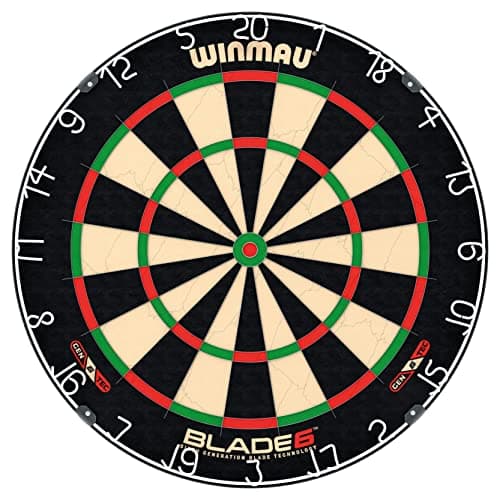 Best regulation board Winmau Blade 6 Single Core Dartboard Full 451 mm sisal face with the thinnest wire system in normal production. | Anyone who wants the measurements on this page and nothing less | $89.00View on Amazon |
| 2 | 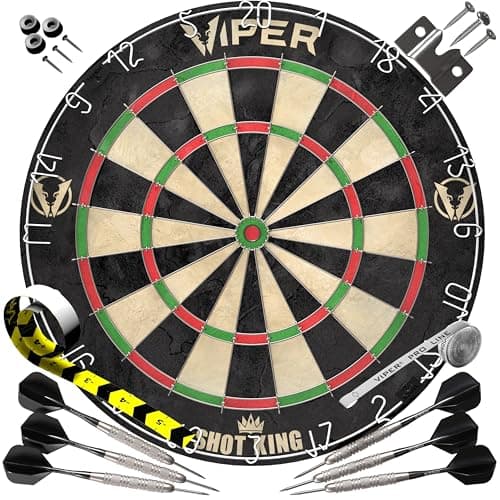 Best budget regulation board Viper Shot King Bristle Dartboard The same 451 mm standard at an entry price, with thicker wire. | A first proper board for a family game room | $44.99$52.9915% offView on Amazon |
| 3 | 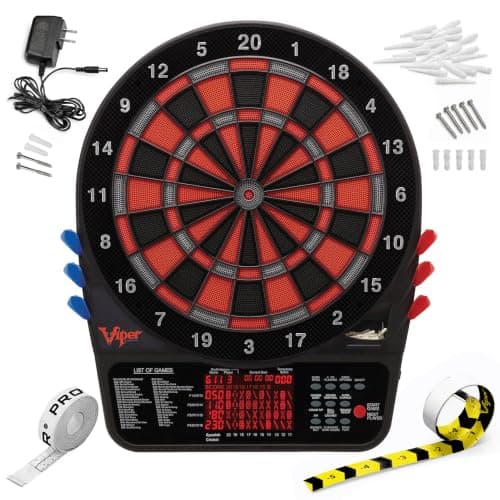 Best soft-tip size Viper 800 Electronic Dartboard A 15.5 in regulation soft-tip target — a different standard, on purpose. | Households where the wall and the floor matter more than tradition | $79.99$157.9949% offView on Amazon |
| 4 | 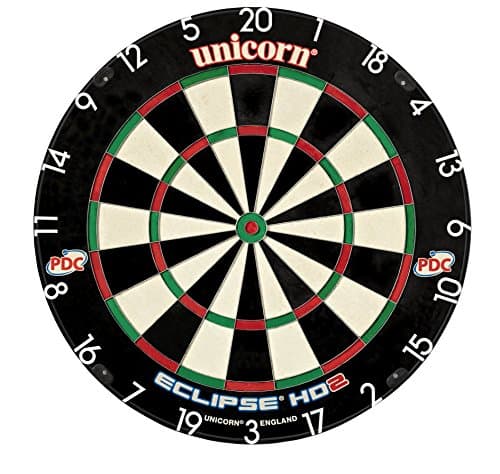 Best thin-wire upgrade Unicorn Eclipse HD2 Pro Dartboard Regulation diameter with the wire pushed about as thin as it goes. | Players chasing the largest possible scoring beds | $96.59View on Amazon |
#ad · Buy links are affiliate links and we earn a commission on qualifying purchases. Prices and product photographs come from the Amazon listing itself and are refreshed daily; the date they were last checked is shown under each buy button. Where a maker does not sell through Amazon there is no product photo, and the card below says so.
1. Best regulation board
Winmau Blade 6 Single Core Dartboard
Winmau
If you have arrived here checking a size, the practical version of the answer is that any proper bristle board from a known brand is built to the 451 mm specification — the standard is tight enough that the diameter is not where boards differ. Where they differ is the wire, and that is what the Blade series is known for.
A thinner wire means the scoring beds are physically wider inside the same 451 mm circle, which is the only legitimate way to make a regulation board more forgiving. The specification stays identical; the amount of the board that is wire rather than sisal goes down. That is why thin-wire boards are what competition play uses.
What we like
- Full 451 mm sisal playing face, built to the published standard
- Thin wire system — more scoring bed inside the same diameter
- Sisal recovers from steel tips rather than tearing
- Rotatable number ring so wear spreads around the board
Worth knowing
- Costs several times what a starter board does
- Steel tip only — not for a soft-tip household
- Needs a surround or a cabinet to protect the wall
Who it’s wrong for
A soft-tip electronic setup, or a first board for small children. Both want a different product entirely.
#ad · We earn a commission on qualifying purchases. How this is funded · Price as of November 9, 2026
2. Best budget regulation board
Viper Shot King Bristle Dartboard
Viper (GLD Products)
A budget bristle board is not a smaller board. The Shot King is built to the same 451 mm face as anything in competition use, and the twenty beds sit in the same places. What you give up is wire thickness and the quality of the staple at the wire junctions, which shows up as slightly more bounce-outs rather than as a different-sized target.
For a house that is finding out whether darts sticks, that is the right trade. The measurements on this page apply exactly, so nobody learns on the wrong geometry and has to relearn later.
What we like
- Regulation 451 mm sisal face at an entry price
- Self-healing sisal, not the paper-faced boards sold below it
- Rotatable number ring
- Mounting hardware included
Worth knowing
- Thicker wire than competition boards — more bounce-outs
- Staples at the wire junctions are the first thing to wear
- No wall protection included
Who it’s wrong for
A keen player who already notices bounce-outs. The thin-wire boards exist for exactly that complaint.
#ad · We earn a commission on qualifying purchases. How this is funded · Price as of November 9, 2026
3. Best soft-tip size
Viper 800 Electronic Dartboard
Viper (GLD Products)
Soft-tip boards are not undersized steel-tip boards. The soft-tip standard is a 15.5 in (394 mm) target face, and every segment is laid out to that figure rather than to 451 mm. Both standards are real; they belong to different games, and dart manufacturers make different darts for each.
The practical consequence is that the throw line also changes — soft-tip play uses 8 ft rather than 7 ft 9.25 in, at the same 5 ft 8 in bull height. If the board is going anywhere near plaster, a soft-tip board at the soft-tip distance is the sane answer.
What we like
- Regulation 15.5 in soft-tip target face
- Plastic tips do not mark plaster or trim
- Automatic scoring across dozens of game modes
- Runs on mains power or batteries depending on model
Worth knowing
- A different size standard — not interchangeable with steel tip
- Segments wear and eventually need replacing
- Misses hit a hard plastic housing rather than sisal
Who it’s wrong for
Anyone practising for a steel-tip league. Train on the geometry you will compete on.
#ad · We earn a commission on qualifying purchases. How this is funded · Price as of November 9, 2026
4. Best thin-wire upgrade
Unicorn Eclipse HD2 Pro Dartboard
Unicorn
The Eclipse HD2 is the other half of the thin-wire argument. Inside the same 451 mm circle it uses an ultra-thin, knife-edged wire and a staple-free bullseye, which means more of every bed is sisal and fewer darts deflect off a junction.
Nothing about the published dimensions changes. The doubles are still 8 mm inside-to-inside; the bull is still 12.7 mm. What changes is how much of that 8 mm you actually get to hit, and at this level that is the whole purchase.
What we like
- Ultra-thin knife-edge wire inside the regulation 451 mm face
- Staple-free bullseye — the usual deflection point removed
- Dense sisal that holds its shape under heavy practice
- The board a lot of televised play is thrown on
Worth knowing
- Among the most expensive boards sold for home use
- Steel tip only
- Overkill for casual weekend play
Who it’s wrong for
A first board. Nobody learning darts will perceive the difference this buys.
#ad · We earn a commission on qualifying purchases. How this is funded · Price as of November 9, 2026
What else is sold
The sizes that are not regulation
Searches for dart board size often end up on products that are deliberately not 451 mm. None of them are frauds — they are just different things, and it is worth knowing which you are looking at.
- Magnetic and velcro boards, roughly 12-15 in. Children's products. The numbers are in the right order but the geometry is not to scale, so nothing learned on one transfers.
- Tabletop and travel boards, under 12 in. Novelty sizing. Fine as a gift, useless as practice.
- Paper-faced boards marked 17.75 in. The diameter is right and the material is wrong. A paper or coiled-wound face takes a hole and keeps it, so the board wears out in weeks rather than years.
- Oversized electronic cabinets. A 20 in or larger housing wrapped around a 15.5 in target. Check the target-face figure in the specification, not the box dimensions.
- Cricket-only and practice faces. Sometimes regulation diameter, sometimes not, and always a reduced segment layout. Read the spec.
Before you mount it
What the size means for the space you need
A 17.75 in board is small. The setup around it is not. You need the board's height, the 7 ft 9.25 in to the oche, room behind the oche to stand and throw, and lateral clearance for the darts that miss. In practice that is a lane of about 5 ft wide by 11 ft long, which rules out more rooms than the board diameter ever will.
The other dimension the diameter implies is wall protection. A miss at the edge of a 451 mm board lands on whatever is next to it, and a steel tip in plaster is a repair rather than a mark. A surround adds roughly 10-12 in of protected radius around the board; a cabinet does the same job and closes. Our dartboard surrounds guide covers which to choose, and dartboard cabinets has the cabinet picks.
Two minutes
How to check a board you already own
- Measure the sisal, not the frame. Tape across the widest part of the playing face, through the bull. You want 451 mm or 17.75 in, within a few millimetres.
- Check the scoring diameter. Double wire to double wire across the board should be about 340 mm / 13.4 in. If the board is regulation diameter but this is short, you are looking at a non-standard face.
- Measure the bull. Half an inch across, with the 25 ring at about 1.25 in. These are the two figures novelty boards never get right.
- Check the ring widths. A double or treble band should measure about 8 mm inside the wires. Visibly wider bands mean a children's or practice face.
- Confirm the number order. 20 at the top, then 1, 18, 4, 13, 6, 10, 15, 2, 17, 3, 19, 7, 16, 8, 11, 14, 9, 12, 5 going clockwise. Any other order is not a dartboard in the scoring sense.
If the board passes all five, its size is fine and anything you dislike about how it plays is wire thickness, sisal density or mounting — all covered in the dartboard buying guide.
Questions
Common questions
What size is a regulation dart board?
How big is the bullseye on a dartboard?
How wide are the double and treble rings?
Are electronic dartboards the same size as bristle boards?
Why do some charts say a dartboard is 453 mm?
What size dartboard should I buy for a family?
Sources
Keep reading
Read next