Guide
How to level a pool table
If the balls drift, the table is not level — and almost no table is level after delivery. The job takes an hour, a long level and a packet of shims.
By Ryder M. · Last updated October 17, 2026 · How we pick

The short answer: level the frame, not the cloth. Set a long spirit level on the bed in six positions — along both long rails, across both short rails and both diagonals — and adjust one leg at a time, always lifting the low corner rather than lowering the high one. Use hardwood or steel shims under the feet for anything more than about a quarter inch, and keep the levellers for fine adjustment only. Allow an hour, and re-check it a month later.
Almost no pool table is level after delivery, and most are not level after assembly either. Floors are not flat, frames settle, and carpet compresses unevenly under weight. The symptom is always the same: a ball left still on the bed starts to move, or a slow shot down the rail curves. Both are the table, not the player, and both are fixable in an evening.
Tools
What you need
- A long spirit level, 4 ft if possible. A 2 ft level works but shows less; a 6 in torpedo level is not adequate for this job and is the reason many tables are declared level when they are not.
- Hardwood shims, or steel shim plate. Not cardboard, not folded paper, not plastic packers that compress. Whatever you put under a table leg carries hundreds of pounds for years.
- An adjustable spanner if the levellers are hex-headed rather than hand-turned.
- Two people, or three for a slate table. Lifting a corner is the part you cannot do alone.
- A cue ball, for the rolling tests. Any ball works, but the cue ball is the one that shows drift most clearly.
- A torch for looking at how the feet actually meet the floor.
If you do not have a long level, a phone level app on a straight-edged board is a workable substitute — more on that below.
Step by step
The method
- Put the table in its final position first. Do not level and then move it; floors vary and the work is specific to where the legs land. If the table is going on carpet, leave it in place for a day before levelling so the carpet compresses.
- Check the floor before the table. Lay the level on the floor where each leg sits, and across the span. A floor that falls more than about half an inch across the table's footprint needs shimming, not levelling, and knowing that now saves an hour of winding levellers to their limit.
- Look at how the feet sit. Any foot not making full contact with the floor is a rocking table, and a rocking table cannot be levelled. Shim that foot until all of them are loaded before touching anything else.
- Level the long axis first. Lay the level on the bed parallel to the long rails, in two positions — near each side. Adjust until both read level.
- Then the short axis. Level across the bed at both ends. Expect the long axis to have shifted slightly; that is normal and it is why the next step exists.
- Then both diagonals. This is the step people skip and it is the one that finds a twisted frame. If both axes read level but a diagonal does not, the table is twisted and one corner needs a shim rather than a leveller turn.
- Go round again. Every adjustment affects the others. Two or three full circuits of long, short, diagonal is normal before everything reads level at once.
- Always lift the low corner. Raising the low corner keeps all four feet loaded. Lowering the high corner unloads it and creates a rock, which puts you back at step three.
- Then roll-test it. Roll a ball very slowly the length of the table, down each rail and across the middle. Then set a ball still in the centre and watch it for ten seconds. Persistent drift in one direction means that side is high.
- Re-check in a month. New tables settle into floors, and a table that was perfect on installation day commonly wants a quarter-turn a few weeks later.
The roll test is the one that matters, because it is the test the game applies. A table can read level on a spirit level and still drift if the bed is not flat — which is the difference between a levelling problem and a bed problem.
Quick picks
Tap any row to jump to the full write-up.
| # | Product | Best for | Price |
|---|---|---|---|
| 1 | 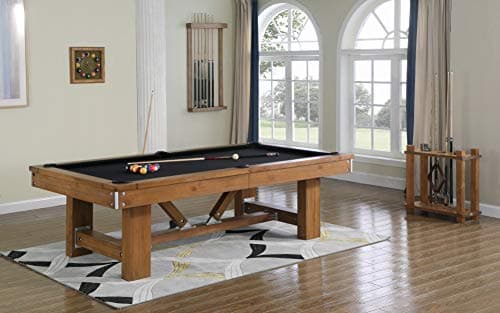 Best table for a floor that is not flat Playcraft Willow Bend 7 ft Slate Pool Table A slate bed on a frame with real levellers — the combination that holds. | Anyone levelling on concrete or an old timber floor | $3,795.00View on Amazon |
| 2 |  Best full-size slate table Brunswick Danbury 8 ft Pool Table Three-piece slate on a frame built to hold a plane across 8 ft. | A permanent 8 ft installation | Check price on Amazon |
| 3 | 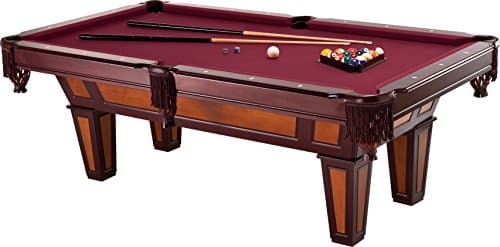 Best MDF table to level Fat Cat Reno 7.5 ft Billiard Table A family table light enough to shim by hand and solid enough to hold. | A first table in a room with an imperfect floor | $1,190.46$1,285.897% offView on Amazon |
#ad · Buy links are affiliate links and we earn a commission on qualifying purchases. Prices and product photographs come from the Amazon listing itself and are refreshed daily; the date they were last checked is shown under each buy button. Where a maker does not sell through Amazon there is no product photo, and the card below says so.
1. Best table for a floor that is not flat
Playcraft Willow Bend 7 ft Slate Pool Table
Playcraft
Levelling is much easier on a table that was built to be levelled. A slate bed on a properly braced frame with threaded levellers at each leg gives you a rigid plane and the adjustment to set it, and once it is set it stays set because nothing in the structure is flexing.
The Willow Bend is that combination at a home price. Slate is the part that matters: a slate bed is flat by nature and stays flat, so levelling it is a question of positioning the frame rather than fighting the bed.
If you are reading this page because a table will not come level no matter what you do, the honest diagnosis is often that the bed itself is not flat. Slate removes that variable permanently.
What we like
- Slate bed is flat by nature and stays flat
- Threaded levellers at each leg for fine adjustment
- Braced frame that does not flex as you adjust
- Holds its level through seasonal humidity changes
Worth knowing
- Heavy — levelling is a two-person job
- Costs more than an MDF table of the same size
- Needs a floor that can take the weight
Who it’s wrong for
A table that may be moved around. Every move means re-levelling, and this one is heavy.
#ad · We earn a commission on qualifying purchases. How this is funded · Price as of November 9, 2026
2. Best full-size slate table
Brunswick Danbury 8 ft Pool Table
Brunswick Billiards
On an 8 ft table the levelling problem gets harder, because the error you are chasing is spread over a longer bed. Three-piece slate on a heavy braced frame is how a table of that size stays flat — the pieces are shimmed and seamed to each other at installation, and the frame is stiff enough that the plane does not move afterwards.
It is also the format that responds properly to adjustment. On a light frame, winding one leveller down flexes the whole cabinet and the far corner moves too. On a frame like this, the corner you adjust is the corner that moves, which makes the job converge rather than chase itself around the table.
Expect to re-check it after the first few weeks. A new table settles into a floor, and a table that was perfect on installation day often needs a quarter-turn a month later.
What we like
- Three-piece slate, seamed flat at installation
- Frame stiff enough that adjusting one corner moves one corner
- Holds level for years once properly set
- The format most installers prefer to work on
Worth knowing
- Genuinely heavy — professional installation is sensible
- Expensive
- Needs a floor rated for the load
Who it’s wrong for
An upstairs room or a floor you are unsure about. Check the load before buying, not after.
#ad · We earn a commission on qualifying purchases. How this is funded
3. Best MDF table to level
Fat Cat Reno 7.5 ft Billiard Table
Fat Cat (GLD Products)
Most people levelling a pool table are levelling an MDF one, and the honest version of that job is different: the bed itself may not be perfectly flat, and the frame will flex a little as you adjust. You are aiming for good rather than perfect, and good is achievable.
The Reno is a reasonable example of the category — a 7.5 ft family table light enough that two people can lift a corner to slide a shim under a leg, which is the move the whole job depends on. Trying to shim a 700 lb slate table without jacks is how people hurt themselves.
Work on the frame rather than the bed. On an MDF table, the bed follows the frame, so getting the frame into a plane is the entire task.
What we like
- Light enough that two people can lift a corner to shim
- Levellers at each leg
- Family price for a 7.5 ft table
- Easy to re-level after a move
Worth knowing
- MDF bed may not be perfectly flat to begin with
- Frame flexes slightly as you adjust
- Humidity changes can move it back out
Who it’s wrong for
A player chasing a true roll. Slate is the answer to that, not a better levelling technique.
#ad · We earn a commission on qualifying purchases. How this is funded · Price as of November 9, 2026
Improvising
Levelling without a proper level
You can do a decent job without a 4 ft spirit level, and plenty of tables in play were set this way.
- A phone level app on a straight board. The app is accurate enough; the board is what makes it useful, by averaging across a span rather than reading one spot. Check the board itself by reversing it end-for-end — if the reading flips, the board is not straight.
- The slow-roll test. Roll a ball as slowly as it will travel from one end to the other, down each rail and up the middle, then repeat in the opposite direction. Consistent curve the same way in both directions means the table is sloping; curve that reverses means the bed has a dip.
- A ball at rest, in nine positions. Set a ball still at each corner, each rail centre and the middle. Anywhere it creeps, that direction is downhill.
- A glass of water is not accurate enough for a pool table. It is a common suggestion and it will find a gross error, nothing finer.
Floors that fight back
The hard cases
A sloping concrete floor. Garage slabs are poured with a deliberate fall toward the door, typically a quarter to half an inch per foot. Across an 8 ft table that is two to four inches, which no leveller can absorb. Shim the low legs up with hardwood or steel plate until the frame is within the levellers' range, then fine-tune. Our best pool tables for a garage page covers choosing a table for that room in the first place.
Carpet. Carpet compresses under load, and it compresses more under a heavier corner. Leave the table in position for a day before levelling, use a wide shim or a load-spreading plate so the foot does not sink further, and expect to re-check after a fortnight. Thick underlay is the worst case and sometimes the honest answer is a hard board under each foot.
Legs with no adjusters. Plenty of budget tables have fixed feet. Shimming is then the only method, and it works — but use hardwood or steel rather than anything that compresses, and cut the shim larger than the foot so the load spreads. Check it again after a month, because a compressed shim is a table back out of level.
An old timber floor. Timber floors move seasonally, so a table on one will need re-levelling once or twice a year. That is not a fault; it is the floor. Keep the level and the shims where you can find them.
Afterwards
How often to do it
Re-check a new table after a month, then once a year, and always after a move. If the table lives on timber or in a room whose humidity swings, twice a year is sensible. The check itself takes five minutes once the table is set up properly — it is the first setup that takes the hour.
A table that needs re-levelling constantly has a structural problem rather than a maintenance one: a flexing frame, a compressing shim, or a bed that has moved. Our how long do pool tables last guide covers which of those are worth repairing.
Questions
Common questions
How do you level a pool table?
Can you level a pool table without a level?
How do I level a pool table on a sloping concrete floor?
What do I use to shim a pool table leg?
Why does my pool table keep going out of level?
How often should a pool table be levelled?
Keep reading
Read next