Roundup
The best pool tables for kids
Four tables children can actually reach across, plus the honest answer on when a junior table stops being enough.
By Ryder M. · Last updated October 6, 2026 · How we pick
Cue & Paddle is reader-funded. If you buy through a link on this page we may earn a commission, at no extra cost to you. It never changes which products we pick or how we rank them — read the full disclosure.
The short answer: for children aged roughly eight and up, a 6ft folding table is the right buy — long enough to teach real angles, short enough to reach, and storable between sessions. For younger children the limiting factor is height rather than length, so a lower portable table is better. For a family who want one table to last into the teenage years, a 6.5ft space-saver with a pair of short cues beats both.
The thing nobody tells you about buying a pool table for a child is that the problem is height. Length gets all the attention, but a regulation table sits at about 31in to the rail — roughly chest height on a seven-year-old — and a child who cannot get the cue level will poke downwards and miss. That is why the picks below are sorted by age rather than by price.
Sizing
Which size for which age
| Child's age | Table size that works | What actually limits them |
|---|---|---|
| 4-6 | Tabletop set on a dining table | Cannot reach over any freestanding bed |
| 6-9 | Portable 6ft at reduced height | Table height, not length |
| 9-12 | 6ft to 6.5ft freestanding | Reach across the bed |
| 12-15 | 6.5ft to 7ft | Wants a real game; outgrows small geometry |
| 15+ | 7ft slate | Playing surface quality starts to matter |
Ages are a guide to reach, not a rule. A tall ten-year-old plays a 7ft table happily; a short twelve-year-old does not.
Quick picks
Tap any row to jump to the full write-up.
| # | Product | Best for | Price |
|---|---|---|---|
| 1 | 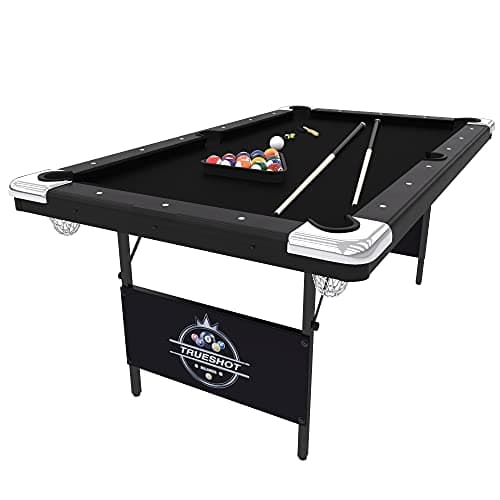 Best overall for kids Fat Cat Trueshot 6 ft Folding Billiard Table A 6ft folding table children can reach and adults can still enjoy. | Families with children roughly eight and older | $546.53$811.9933% offView on Amazon |
| 2 | 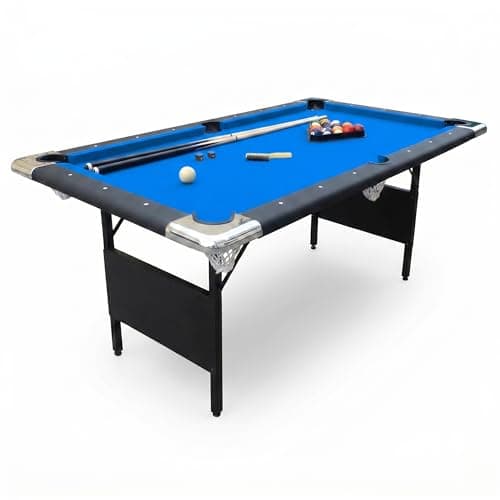 Best for younger children Hathaway Fairmont 6 ft Portable Pool Table A portable 6ft table at a height a younger child can use standing. | Children around six to ten in a shared living space | $399.99View on Amazon |
| 3 | 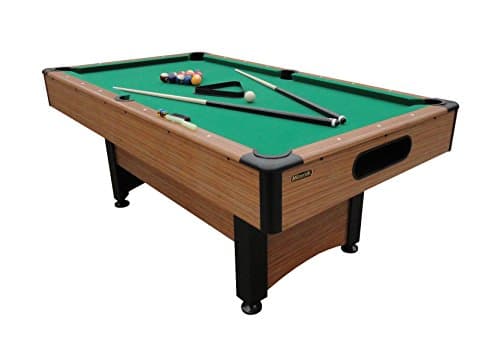 Best table to grow into Mizerak Dynasty Space Saver 6.5 ft Billiard Table A 6.5ft table with a narrower cabinet than its size suggests. | Families who want one table to last from nine into the teens | $999.99View on Amazon |
| 4 | 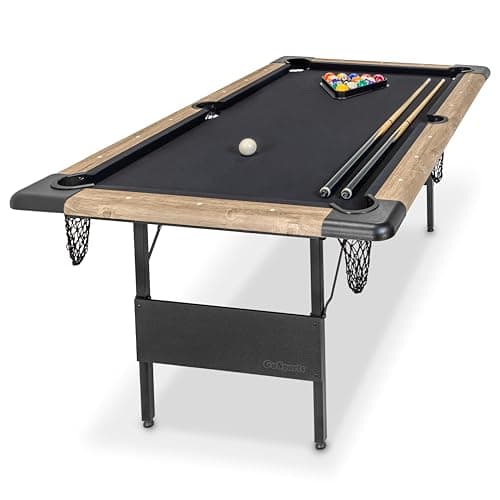 Best budget starter GoSports 6 ft Foldable Pool Table The cheapest table here that still plays a real game of pool. | Testing whether the interest is real before spending more | $399.99View on Amazon |
#ad · Buy links are affiliate links and we earn a commission on qualifying purchases. Prices and product photographs come from the Amazon listing itself and are refreshed daily; the date they were last checked is shown under each buy button. Where a maker does not sell through Amazon there is no product photo, and the card below says so.
1. Best overall for kids
Fat Cat Trueshot 6 ft Folding Billiard Table
Fat Cat (GLD Products)
Six feet is the size that works for a mixed-age household. It is short enough that a child of eight or nine can reach the middle of the table without climbing onto it, and long enough that an adult game is not comical. Below 6ft the geometry changes — the pockets sit too close together and the game becomes a tap-in exercise that teaches nothing about angles.
Folding legs are the feature that keeps this kind of table in use. A table that lives permanently in the middle of a family room gets resented; one that folds flat against a wall after a session stays welcome. It also means the table can disappear for a party and come back out afterwards.
Expect the bundled cues to be the weak part. They almost always are, and on a children's table they matter more than usual, because a warped cue teaches a child that they cannot aim. One straight pair of shorter cues transforms the experience — our accessories guide covers what to replace first.
What we like
- 6ft length — reachable for most children over eight, still playable for adults
- Folds flat for storage between sessions
- Light enough for two people to move without planning it
- Low enough price that scratches are not a tragedy
Worth knowing
- Engineered bed, so the roll is softer than slate
- Bundled cues need replacing early
- The folding mechanism is the part that eventually wears
Who it’s wrong for
A child under about six, who cannot see across a 6ft bed. A tabletop set is a better starting point at that age.
#ad · We earn a commission on qualifying purchases. How this is funded · Price as of November 9, 2026
2. Best for younger children
Hathaway Fairmont 6 ft Portable Pool Table
Hathaway
Height, not length, is what stops young children playing pool. A regulation table sits at about 31in to the rail, which puts the bed at roughly chest height on a seven-year-old — they cannot get a level cue across it, so they poke downwards and nothing goes where they aimed. A lower portable table fixes the cause rather than the symptom.
The Fairmont's other advantage is that it comes apart. Folding legs and a carryable cabinet mean the table can live in a cupboard and appear on a wet Saturday, which in a house without a dedicated game room is the difference between a table that gets played and a table that becomes a shelf.
Buy it knowing it is a stepping stone. A child who gets properly interested will want a 7ft slate table by their early teens, and this table will not satisfy them then. That is not a flaw — it will have done its job.
What we like
- Lower playing height suits children who cannot reach a full table
- Portable — stores away between sessions
- Full ball set and a usable rack included
- Cheap enough to hand on when it is outgrown
Worth knowing
- Short legs make it uncomfortable for tall adults
- Light cabinet shifts if someone leans on it
- Definitely a starter table, not a keeper
Who it’s wrong for
A household of adults who want to play properly. You would be buying again within a year — start at best small pool tables instead.
#ad · We earn a commission on qualifying purchases. How this is funded · Price as of November 9, 2026
3. Best table to grow into
Mizerak Dynasty Space Saver 6.5 ft Billiard Table
Mizerak
The gap between a child's table and a real table is where most families get stuck. A 6.5ft table with a slim cabinet is the honest middle: a nine-year-old can play it now, a fifteen-year-old will still want to, and it fits a room that cannot take a 7ft table with a full cue swing.
The space-saver cabinet is the specific reason it belongs on a kids' list. Narrower rails mean a child's reach covers more of the bed, and the table takes a smaller footprint in a room that doubles as a sitting room. The bed is engineered rather than slate, which on a family table is a reasonable trade — it is the component you would upgrade if the household got serious.
Set it up with a pair of 48in short cues alongside the standard ones. Children handle a short cue far better, and it is exactly what you want at whichever end of the room is tight anyway.
What we like
- 6.5ft play in a cabinet narrower than the size implies
- Grows with a child from roughly nine into the teens
- Short cues make it genuinely usable by younger players
- Comes apart for a house move
Worth knowing
- Engineered bed — a soft roll on slow shots
- Not a folding table, so it stays in the room
- Needs a dry room; composite beds dislike damp
Who it’s wrong for
A child under about eight playing alone. The bed is too long for them to reach without climbing on it.
#ad · We earn a commission on qualifying purchases. How this is funded · Price as of November 9, 2026
4. Best budget starter
GoSports 6 ft Foldable Pool Table
GoSports
There is a sensible version of buying cheap: you do not know yet whether the interest will last, and a table costing a tenth of a slate table answers that question. At 6 feet it is a real playing field rather than the squashed geometry of a toy table, so a child learns genuine angles on it.
What you give up is build quality in every component — the bed, the cloth, the pockets and the cues. Balls will rattle in pockets a better table would drop, the cloth shows wear within a year of hard play, and the levelling adjustment is crude. None of that stops a family playing hundreds of games on it.
Treat the first year as the trial. If the table is still in use after twelve months you have learned something worth knowing and can buy slate with confidence. If it is not, you spent very little finding out.
What we like
- A real 6ft playing field at an entry price
- Real pocket geometry, so children learn actual angles
- Folding legs, so it moves and stores easily
- Low enough cost to treat as a trial
Worth knowing
- Softest playing surface here — slow rolls wander
- Cloth and pockets wear visibly within a couple of years
- Crude levelling; expect to shim
Who it’s wrong for
A household that already knows it wants pool for the long run. Put the money toward a sectioned slate table instead — see best pool tables under $1,000.
#ad · We earn a commission on qualifying purchases. How this is funded · Price as of November 9, 2026
How long it lasts
The growth problem, stated honestly
A junior table has a working life of roughly three years with one child, in the sense of staying interesting rather than falling apart. They grow into it, they enjoy it, and then they reach the point where the pockets feel too generous and the shots feel too short. Buy at age seven and expect the conversation about a bigger table at around ten or eleven.
There are two honest ways to handle that. Buy cheap deliberately, accept the three-year life and hand the table on — which is what the budget pick above is for. Or buy a 6.5ft table with short cues now, which a child can use at nine and still want at fifteen. The second costs more up front and less overall. What does not work is buying a toy-size table for an eleven-year-old because it was on offer.
Practicalities
Safety and setup with children in the house
- Short cues, always. A 48in cue is safer indoors and far easier for a child to control than a 57in one. Keep a pair in the rack whatever the table.
- Store cues vertically and out of reach. A cue leaning in a corner is both a warping cue and a weapon. A wall rack solves both problems at once.
- Operate the folding mechanism yourself first. On folding tables the latch is the one component a child can get fingers into. Work it a few times before you let them.
- Count the balls back in. A 2.25in pool ball is a hard, heavy object and a choking hazard for a toddler sibling. Count them into the rack after every session.
- Weight the base if the table is light. A portable table that moves when leaned on invites leaning. Sandbags on the cross-brace stop it dead.
- Level it properly. Children blame themselves for a table that rolls off line; adults blame the table. Level it and most of the frustration disappears.
Not worth it
What to skip
- Toy tables under about 40in. The pockets sit so close together that nothing is learned about angles, and children see through them quickly.
- Novelty ball sets. Printed polyester balls roll worse than the set in the box and get lost faster.
- Tables with a plastic playing surface. Cloth matters. A vinyl bed plays nothing like pool and puts children off the game rather than into it.
- A second accessory kit. It is the same low-grade cues again. Buy one straight short pair instead.
One age band needs a different table entirely. A teenager stoops over a kids' table, finds the cue ball barely travels, and stops using it — so if the main player is thirteen or older, buy for them and let younger siblings use a step. Best pool tables for teens covers that buyer.
Questions
Common questions
What size pool table is best for a child?
At what age can a child play pool?
Should you buy a cheap pool table for kids?
Do kids need shorter pool cues?
How long will a kids' pool table last?
Keep reading
Read next