Roundup
The best pool tables for a basement
A basement is the right room for a pool table and the hardest room to get one into. These five are picked for the stairs, the ceiling and the humidity.
By Ryder M. · Last updated October 6, 2026 · How we pick
Cue & Paddle is reader-funded. If you buy through a link on this page we may earn a commission, at no extra cost to you. It never changes which products we pick or how we rank them — read the full disclosure.
The short answer: for most finished basements a 7.5ft table with a three-piece slate bed and knock-down construction is the right buy, because sectioned slate is the only kind that gets down a domestic staircase. If the basement has 8ft ceilings and roughly 17ft by 13ft clear of posts, step up to 8ft. If the stair turns tightly, drop to a lighter engineered-bed table instead of fighting the house.
Basements are the best room in the house for a pool table and the worst room to deliver one to. Three things decide which table you can have, and none of them is budget: how the slate gets down the stairs, how much headroom there is over the table, and how much moisture the room holds in summer. This page works through all three, then names the tables that suit each answer.
Before you order
Measure these four things first
| Measurement | Why it matters | The number to beat |
|---|---|---|
| Clear floor, obstruction to obstruction | Cue clearance behind every rail | 7ft table: about 16ft 6in x 12ft 6in |
| Ceiling height over the table | Raised cues and the light fitting | 7ft 6in or more for a pendant light |
| Stair landing diagonal | Whether a slate section can turn | Roughly 40in clear on the diagonal |
| Narrowest door or bulkhead | Getting cabinet and rail sections through | Wider than the rail sections, roughly 30in |
| Summer relative humidity | Cloth life and composite bed swelling | Below 60% |
Measure to the nearest obstruction — a support post, the stair box, the furnace housing — not to the nearest wall. That one habit prevents most basement sizing mistakes.
Quick picks
Tap any row to jump to the full write-up.
| # | Product | Best for | Price |
|---|---|---|---|
| 1 | 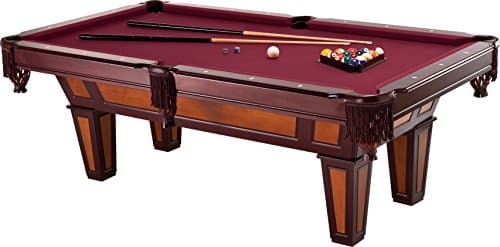 Best overall for a basement Fat Cat Reno 7.5 ft Billiard Table A 7.5ft slate table that breaks down into pieces that fit a domestic staircase. | A finished basement with a straight stair flight and 8ft ceilings | $1,190.46$1,285.897% offView on Amazon |
| 2 | 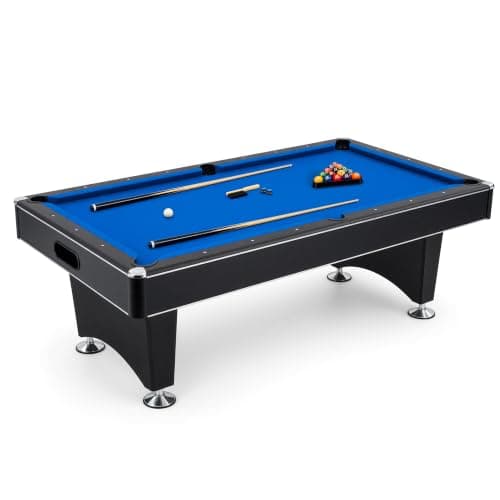 Best for a big basement Hathaway Hustler 8 ft Pool Table An 8ft table for a basement that genuinely has the room for one. | An open basement of roughly 17ft by 13ft or larger | $999.99View on Amazon |
| 3 | 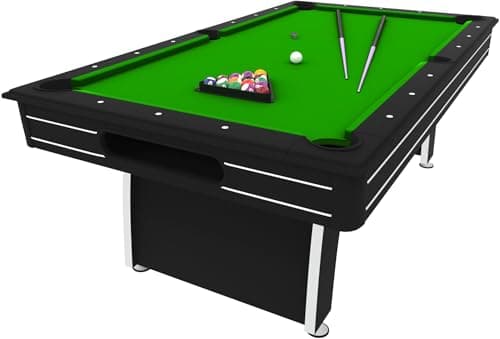 Best for low ceilings Fat Cat Tucson 7 ft Billiard Table A 7ft slate table that leaves headroom for a light under a low ceiling. | Basements with 7ft to 7ft 6in of headroom | $1,023.99View on Amazon |
| 4 | 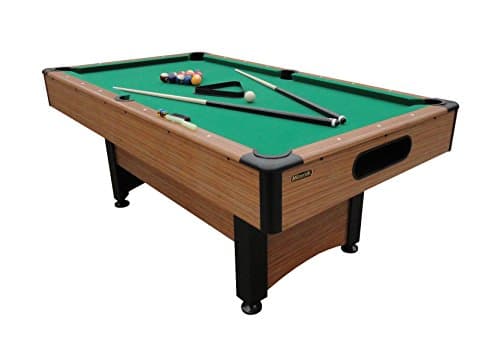 Best for a tight stairwell Mizerak Dynasty Space Saver 6.5 ft Billiard Table A 6.5ft table light enough to carry down a turning stair. | Basements where a slate section will not make the turn | $999.99View on Amazon |
| 5 | 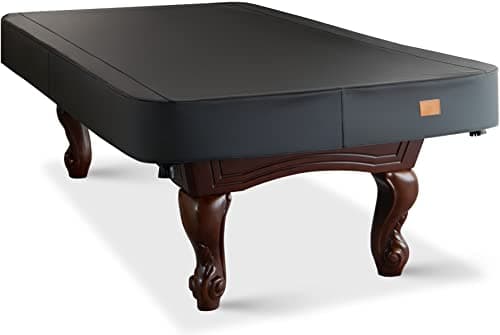 Best protection for a basement table BearCover Heavy-Duty Fitted Pool Table Cover The cheapest thing you can do about basement dust and damp. | Any basement table that is not played every day | $39.99View on Amazon |
#ad · Buy links are affiliate links and we earn a commission on qualifying purchases. Prices and product photographs come from the Amazon listing itself and are refreshed daily; the date they were last checked is shown under each buy button. Where a maker does not sell through Amazon there is no product photo, and the card below says so.
1. Best overall for a basement
Fat Cat Reno 7.5 ft Billiard Table
Fat Cat (GLD Products)
The reason a slate table is hard to put in a basement is not the table, it is the slate. A single-piece bed cannot be turned on a stair landing, and a three-piece bed can — each section is a two-person carry on a straight flight, and the sections are bolted and levelled once they are in the room. The Reno ships as a knock-down table with a sectioned bed, which is the specification that matters here far more than anything about the cloth or the finish.
At 7.5ft it is about the largest table most basements should take, and that is not a floor-area judgement. It is about the cue. A 58in cue needs roughly five feet of clear space behind each rail, and basements lose space to the stair box, a support post and the furnace housing in ways a garage does not. Measuring to the nearest obstruction rather than the nearest wall is the step people skip.
Levelling matters more in a basement than anywhere else in the house, because a concrete slab is rarely flat and a slate bed shows a drift that an engineered bed hides. Budget an afternoon with a long level and a bag of shims, or pay for assembly — the table then plays correctly for a decade.
What we like
- Three-piece slate bed — each section is carryable on a straight stair flight
- 7.5ft fits a typical finished basement with full-length cues
- Knock-down construction, so it can come back out again
- Slate shrugs off basement humidity better than a wood-composite bed
Worth knowing
- Still a heavy table — two strong people minimum, four is realistic
- Needs careful levelling on a concrete slab
- Assembly is a genuine job, not a half hour
Who it’s wrong for
A basement reached by a turning stair with a tight landing. Measure the landing diagonal first — if a slate section will not turn, the table will not get in.
#ad · We earn a commission on qualifying purchases. How this is funded · Price as of November 9, 2026
2. Best for a big basement
Hathaway Hustler 8 ft Pool Table
Hathaway
Eight feet is the size most buyers want and most basements cannot take. The clearance arithmetic is unforgiving: an 8ft table needs about 17ft 4in by 13ft 4in for comfortable play with full-length cues. If your basement measures that between obstructions, the step up from 7ft is worth taking — longer shots, a proper break, and a room that feels like a pool room rather than a compromise.
The Hustler is specified for this job rather than for a showroom. The bed is slate, the rails are bolted through, and it arrives knocked down, which is the only honest way to sell an 8ft table to someone with a staircase. The finish is plain, and in a basement that is an advantage — there is no delicate veneer to swell against a cold external wall.
If the arithmetic comes out short by a foot in one direction, do not drop a whole table size straight away. A pair of 48in or 52in short cues solves one tight end for a fraction of the cost, and they live in the rack beside the full-length pair.
What we like
- Full 8ft play — the size most buyers actually want
- Slate bed, bolted rails and knock-down assembly
- Plain finish that copes with a cool, variable basement
- Playing surface good enough to improve your game on
Worth knowing
- Needs about 17ft by 13ft clear of posts and the stair box
- Heaviest table on this list to move in
- No decorative detail — this is a playing table
Who it’s wrong for
A basement with a support post anywhere near the middle of the room. Run the numbers in the room size guide before you commit to 8ft.
#ad · We earn a commission on qualifying purchases. How this is funded · Price as of November 9, 2026
3. Best for low ceilings
Fat Cat Tucson 7 ft Billiard Table
Fat Cat (GLD Products)
Low ceilings are the second basement problem, and they bite in two places. A hanging light over the table has to clear a raised cue, and an overhead stroke on a jump or a masse shot needs more room than people expect. Under about 7ft 6in you want the smaller table and the light flush-mounted rather than pendant.
A 7ft table is the sweet spot for that. It plays properly with full-length cues in a room an 8ft table would make unplayable, and at the Tucson's dimensions you can keep a walking lane on all four sides even in a basement that has lost a strip to the stair box.
The practical move under a low ceiling is to light the table with two recessed fittings either side of centre rather than one pendant. You lose the pool-hall look and gain the ability to lift a cue without thinking about it.
What we like
- 7ft slate bed — proper play in a room that cannot take 8ft
- Leaves headroom for a flush or recessed light
- Sectioned slate for stair access
- Keeps a walking lane on all four sides in a typical basement
Worth knowing
- Shorter shots than an 8ft table — regular players notice
- Still needs levelling on a slab
- Pendant lighting is off the table, literally
Who it’s wrong for
A basement with 8ft ceilings and the floor area for a bigger table. You would be leaving play on the table for no reason.
#ad · We earn a commission on qualifying purchases. How this is funded · Price as of November 9, 2026
4. Best for a tight stairwell
Mizerak Dynasty Space Saver 6.5 ft Billiard Table
Mizerak
Some basements will simply not take slate. A turning stair with a small landing, a door at the bottom that opens into the stairwell, a bulkhead over the last three steps — any of those can defeat a slate section no matter how many people you have. That is the moment to choose an engineered bed honestly rather than fight the house.
The Dynasty Space Saver is built to be moved. The bed is a wood composite rather than stone, the cabinet is narrower than a standard 6.5ft table, and the whole thing goes down a flight in pieces one person can manage. The playing surface is not slate and does not pretend to be — the roll is fine for family play and will not satisfy anyone who plays in a league.
Keep it away from a damp wall. Composite beds take up moisture at the edges, and a basement that smells of damp in August will find the weakness eventually. A dehumidifier costs less than a replacement bed.
What we like
- Light enough for a turning stair, and carryable in pieces
- Narrower cabinet than a standard 6.5ft table
- Cheapest route to a real table in a difficult basement
- Comes apart again when you move house
Worth knowing
- Engineered bed, not slate — the roll is noticeably softer
- Vulnerable to sustained damp
- 6.5ft play feels short after a session on a 7ft table
Who it’s wrong for
A dry basement with straight stairs. If slate will physically fit, buy slate — see slate vs MDF for what you give up.
#ad · We earn a commission on qualifying purchases. How this is funded · Price as of November 9, 2026
5. Best protection for a basement table
BearCover Heavy-Duty Fitted Pool Table Cover
BearCover
Basements are dustier than the rest of the house and they move more moisture. Both go for the cloth: airborne grit gets ground in under the balls, and humid air relaxes the nap so the table plays slow before it plays badly. A fitted cover deals with the dust completely and slows the moisture down.
Fitted is the word that matters. A loose sheet gets dragged over the rails, slides off and ends up behind the furnace. A cover cut for your table size pulls on in one movement, which is why it actually gets used — which is the entire point of it.
In a basement with a real humidity problem, pair it with a small dehumidifier rather than relying on the cover alone. Vinyl can trap moisture against the cloth in a genuinely damp room, so leave the table uncovered for a day after a wet spell.
What we like
- Stops ground-in basement dust, the main thing that ages cloth
- Fitted, so it stays on and gets used
- Turns the table into a usable surface between games
- Costs a tiny fraction of recovering a table
Worth knowing
- Must match your table size — measure the cabinet, not the slate
- Can trap moisture in a genuinely damp room
- Adds a step before every game
Who it’s wrong for
An outdoor or patio table exposed to standing water, which needs a weatherproof cover rather than an indoor dust cover.
#ad · We earn a commission on qualifying purchases. How this is funded · Price as of November 9, 2026
The real decision
Slate or engineered bed in a basement?
In a dry basement with straight stairs, buy slate. It is flatter, it stays flat, it does not care about seasonal humidity, and a sectioned bed is specifically designed to be carried in pieces. The weight is a one-day problem and the playing surface is a ten-year benefit.
In a basement where the stairs turn tightly or the only access is through a bulkhead, an engineered bed is the honest choice. You give up roll accuracy — a slow ball drifts in a way it does not on stone — but you get a table in the room rather than a table in the garage. The full trade-off is in our slate vs MDF comparison, and the weight figures that decide the delivery are in how heavy is a pool table.
Room conditions
Damp, cold and the things basements do to tables
- Humidity relaxes cloth. Above roughly 60% relative humidity the nap softens and the table plays slow. A dehumidifier set to 50% fixes it permanently and costs less than recovering the table.
- Composite beds swell at the edges. If you have bought an engineered-bed table, keep at least four inches between the cabinet and any external wall so air can move behind it.
- Concrete slabs are not flat. Expect to shim. A long spirit level across the bed in both directions and along both diagonals tells you everything you need to know.
- Cold makes a table feel dead. A table in an unheated basement at 50F plays noticeably slower. That is the air and the cloth, not a fault in the table.
- Dust is constant. Basements carry more airborne grit than living rooms. Brush along the nap every few sessions and keep the table covered between them.
Delivery
Getting a table down the stairs
- Measure the landing diagonal and the narrowest doorway before you order anything. Those two numbers set your ceiling on table weight.
- Check the table ships knocked down. A single-piece slate bed is not going into a basement, full stop.
- Clear the whole route, including removing the stair handrail if it comes off. Handrails take more width than people assume.
- Plan where the slate sections rest while the cabinet goes together — on edge against a wall, on blankets, never flat on a cold slab.
- Assemble the cabinet in its final position. You cannot slide a levelled slate table across a concrete floor without starting again.
- Level the bed, then cloth it and fit the rails. Levelling last is the most common assembly mistake.
If that reads as more than you want to take on, paid assembly is widely available and typically costs a fraction of the table. It is also the right call when the table is a gift — nobody wants their present to arrive as an afternoon of shimming. For how the whole cost stacks up, see how much a pool table costs.
A basement is also the room that solves the other problem with a teenager's pool table: the noise. A break carries through a floor and teenagers play late, which is why a table directly above a living room gets played less whatever its specification. Best pool tables for teens has the picks sized for that room.
Questions
Common questions
What size pool table is best for a basement?
Can you get a slate pool table into a basement?
Is a basement too damp for a pool table?
What ceiling height do you need for a pool table?
Does a pool table need to be level in a basement?
Keep reading
Read next