Roundup
Best pool cues under $200
Two hundred dollars is the band where a cue stops being decoration and starts being equipment. It is also the band where the marketing gets loudest, so here is what the money actually buys.
By Ryder M. · Last updated November 10, 2026 · How we pick
Cue & Paddle is reader-funded. If you buy through a link on this page we may earn a commission, at no extra cost to you. It never changes which products we pick or how we rank them — read the full disclosure.
The verdict: the Players C-960 is the cue to buy under $200 - a hard maple shaft with a properly cut pro taper, a machined steel joint and a replaceable tip, from a brand that makes nothing but cues. The budget pick is the Aska House Cue Set, four matched cues for less than one of the others, which is the right purchase when the problem is that four people are sharing two warped sticks rather than that one player needs a better cue. If the cue should look like something as well as play, the McDermott Lucky L9 is the one.
First, the baseline. A typical two-piece pool cue is made mostly of hard or rock maple, with a fibreglass or phenolic resin ferrule between about three-quarters of an inch and an inch long, and steel joint collars and pin. Pool cues average around 59 inches long, are commonly sold between 17 and 21 ounces with 19 ounces the most common, and have a tip diameter of roughly 12 to 14 mm. Any cue in this band should meet that description. If a listing will not tell you the weight or the tip diameter, that is the answer.
The honest trade
What $200 buys, and what it does not
It buys three things. A straight, properly tapered maple shaft, so the cue slides through the bridge hand cleanly on a long stroke. A tip that holds chalk and can be replaced when it glazes. And a machined joint, so the two halves tighten to the same position every time and the hit does not get absorbed at the seam. Those three are most of the difference between a cue and a stick.
What it does not buy is a low-deflection shaft. Deflection - the cue ball squirting off line when you strike with side-spin - is addressed with specialised shaft construction and sometimes lighter ferrule materials such as titanium, and that engineering sits above this band. For a home player that is a reasonable thing to go without, because deflection only becomes the limiting factor once your stroke is repeatable enough for it to be measurable.
It also does not buy a case, a tip tool or chalk that is worth using. Budget for those separately. The single cheapest upgrade after the cue itself is decent chalk, and best pool table accessories covers the rest of the list.
Criteria first
What decides a cue in this band
1. Straightness, and how you check it. Roll the shaft on the table bed. A cue that rocks or whose tip lifts is warped, and a warped cue cannot be fixed. This is worth doing on arrival, because it is the one defect that makes the cue useless and the one most likely to arrive from a warehouse.
2. Weight, and sticking to it. Nineteen ounces is the most common weight and a sensible default. What matters more than the number is using the same number consistently - swapping between a 17 oz and a 21 oz cue makes your stroke unlearn itself.
3. The tip. A tip that will take chalk and hold it is the difference between controlling the cue ball and hoping. Tips are consumable and replaceable; a cue whose tip cannot be replaced is not a cue to buy at this price.
4. The joint. Steel collars and a machined pin. A joint that bottoms out inconsistently makes the cue feel different shot to shot, which is worse than a cue that is simply mediocre and consistent.
5. Tip diameter, against the game. Twelve to fourteen millimetres is standard for pool. Thinner shafts are a snooker and carom thing, and a snooker-spec cue on a pool table is a mismatch rather than a refinement - see pool table vs snooker table for why the equipment diverges.
The numbers
Cue specifications worth knowing
| Specification | Pool | Snooker | Carom |
|---|---|---|---|
| Typical length | About 59 in | 57-58 in | 54-56 in |
| Common weight | 17-21 oz, 19 oz most common | Similar range | 16.5-18.5 oz |
| Tip diameter | 12-14 mm | Narrower | 11-12 mm |
| Shaft material | Hard or rock maple | Often ash | Varies; usually handmade |
| Ferrule | Fibreglass or phenolic resin, 0.75-1 in | Often brass | Varies |
Figures are the standard specifications for each game. A cue bought for pool should sit in the pool column - cues for the other two games are built stiffer or narrower for different balls and are not upgrades for pool.
Quick picks
Tap any row to jump to the full write-up.
| # | Product | Best for | Price |
|---|---|---|---|
| 1 | 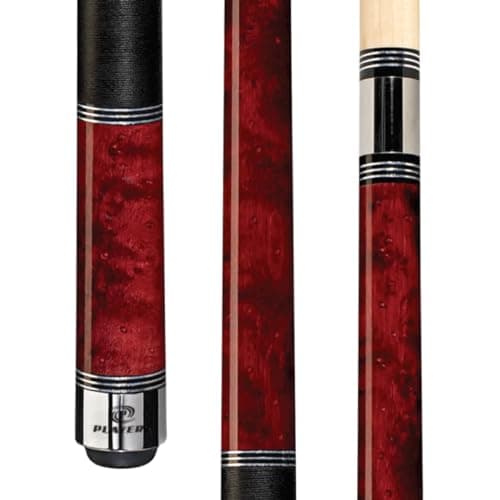 Best under $200 overall Players C-960 Pool Cue A maple cue with a pro taper and a proper ferrule, from a brand that only makes cues. | A regular player replacing a house cue for good | $179.10View on Amazon |
| 2 | 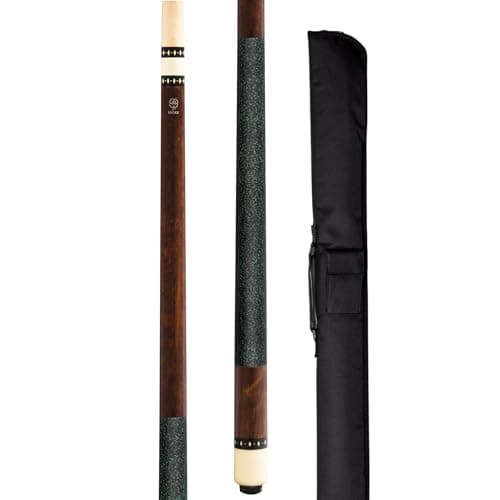 Best looking under $200 McDermott Lucky L9 Pool Cue A McDermott-badged cue at the bottom of the brand's range, with the brand's shaft work. | A player who wants the cue to look like a cue as well as play like one | $150.00View on Amazon |
| 3 | 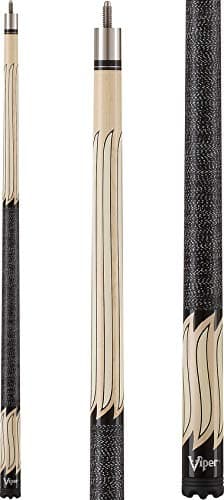 Best first upgrade Viper Sinister Two-Piece Pool Cue A two-piece maple cue at the bottom of the band, and a clear step up from any house cue. | A first personal cue, or a second cue for guests who play often | $123.99View on Amazon |
| 4 | 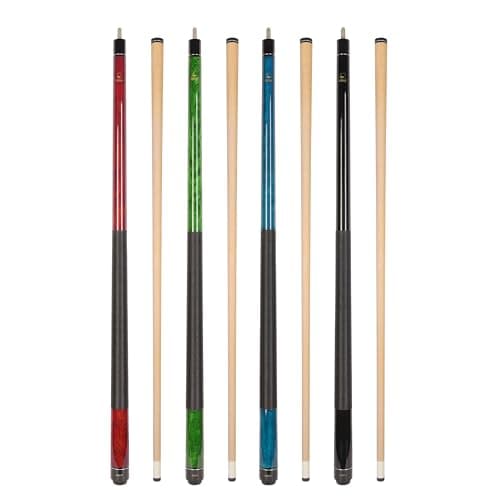 Budget pick Aska House Cue Set (4-Pack) Four matched cues for less than one of the cues above - the right answer for a shared table. | A games room where four people play and nobody owns a cue | $89.95View on Amazon |
#ad · Buy links are affiliate links and we earn a commission on qualifying purchases. Prices and product photographs come from the Amazon listing itself and are refreshed daily; the date they were last checked is shown under each buy button. Where a maker does not sell through Amazon there is no product photo, and the card below says so.
1. Best under $200 overall
Players C-960 Pool Cue
Players
A typical two-piece pool cue is mostly hard or rock maple, with a fibreglass or phenolic resin ferrule roughly three-quarters of an inch to an inch long, and steel joint collars and pin. The Players C-960 is that description executed properly rather than approximated, which is what separates a cue at this price from a cue at a third of it.
What you feel first is the taper. Pool cues average around 59 inches and the shaft tapers conically from joint to tip, and a well-cut taper is what lets the shaft slide cleanly through the bridge hand on a long follow-through. House cues are cut cheap and fast, and the hitch you feel on a long shot is the taper, not your stroke.
The second thing is the joint. Steel collars and a machined pin mean the two halves tighten to the same place every time and the energy of the hit does not get lost at the seam. That is why a two-piece cue at this price can feel more solid than a one-piece house cue, which is counterintuitive until you have played with both.
What we like
- Hard maple shaft with a properly cut pro taper
- Machined steel joint, so the cue reassembles identically every time
- Replaceable tip, which makes the cue a long-term purchase
- Weight options around the common 19 oz mark
Worth knowing
- Plain by the standards of the decorated cues at this price
- Still a standard maple shaft, not a low-deflection one
- Needs a case; the cue is the purchase, the case is extra
Who it’s wrong for
A player who mainly wants a cue that looks good on the wall. For that, see the decorated pick below - it plays well and looks like something.
#ad · We earn a commission on qualifying purchases. How this is funded · Price as of November 10, 2026
2. Best looking under $200
McDermott Lucky L9 Pool Cue
McDermott
McDermott's Lucky line is the brand's entry series, and the honest read is that it is built to a price in the areas you cannot see and to McDermott's usual standard in the areas you can. For a home player that is a reasonable set of priorities: the shaft, the tip and the joint are the parts that matter, and the Lucky keeps them.
The visual difference against the plain cue above is real and it is not trivial. A cue that gets left out on a rack in a games room is part of the room, and a cue somebody actually wants to pick up gets picked up. That is not a playing specification but it is a usage one.
Where it is beaten is in the long run. The Players cue above has a slightly better-specified shaft for the money, and over years of play the shaft is what you notice. If the cue will live in a case and get used three times a week, buy the plainer one.
What we like
- A genuine McDermott shaft at the bottom of the brand's price range
- Finish and inlay work well above the plain cues at this price
- Standard joint and replaceable tip
- The cue most likely to actually get used in a shared games room
Worth knowing
- Entry-series construction in the areas you cannot see
- Shaft is specified slightly below the Players cue at similar money
- Decorated wraps mark more visibly than plain ones
Who it’s wrong for
A player chasing the best stroke per dollar. The money here partly buys appearance, which is a legitimate purchase but not a playing one.
#ad · We earn a commission on qualifying purchases. How this is funded · Price as of November 10, 2026
3. Best first upgrade
Viper Sinister Two-Piece Pool Cue
Viper (GLD Products)
Viper is GLD Products' games-room line, and the Sinister is its mainstream two-piece cue. It is well under the $200 ceiling, and the comparison that matters is not against the cues above but against the house cue it replaces - and against a house cue it is not close.
What changes is consistency. A house cue is warped, its tip is glazed hard, and its joint, if it has one, is loose. A cue like this is straight, has a tip that holds chalk, and tightens to the same point every time. Those three things together are most of what people mean when they say a cue feels better.
What it does not have is a premium shaft. The taper is standard rather than refined and the ferrule is the basic specification. For a player who plays weekly, that ceiling arrives in a year or two. For a player who plays monthly, it may never arrive at all.
What we like
- Straight maple shaft with a tip that holds chalk, which no house cue does
- Comfortably under the band ceiling, leaving budget for a case
- Standard joint and replaceable tip
- Cheap enough to buy two, which solves the guest problem
Worth knowing
- Standard taper rather than a refined one
- Basic ferrule specification
- A weekly player will outgrow it
Who it’s wrong for
A league player. It is a good cue for the money and it is not a competition cue - buy the Players cue above instead.
#ad · We earn a commission on qualifying purchases. How this is funded · Price as of November 10, 2026
4. Budget pick
Aska House Cue Set (4-Pack)
Aska
This is the budget pick, and it is solving a different problem from the three cues above: not how good can one cue be, but how do four people stop fighting over two warped sticks. A matched four-cue set at this price is the cheapest thing that measurably improves a home table, because the thing wrong with most home tables is the cues that came in the box.
They are house cues, and this page is not going to pretend otherwise. One-piece construction, basic tips, standard weights. What they are is straight, matched and new, which is three things the cues in a table's accessory bundle usually are not.
The sensible pattern for a shared games room is this set for guests plus one good two-piece cue for whoever plays most. That costs less than two mid-range cues and makes the table better for everyone.
What we like
- Four matched cues for less than the price of one cue above
- Straight and new, which beats any supplied bundle cue
- Standard weights, so players can find one that suits them
- The cheapest meaningful upgrade to a home table
Worth knowing
- One-piece house cues - no joint, no shaft refinement
- Basic tips that glaze and need replacing or scuffing
- No case or storage; budget for a wall rack
Who it’s wrong for
Anyone buying a cue for themselves. This is the guest-cue solution, and a personal cue should be one of the two-piece cues above.
#ad · We earn a commission on qualifying purchases. How this is funded · Price as of November 10, 2026
The failure modes
Where cheap cues actually fail
- Warp. The defect that cannot be fixed. Store cues vertically in a rack or flat in a case, never leaning against a wall or standing in a damp garage.
- A glazed tip. A tip that has gone hard and shiny will not hold chalk, and no amount of chalk fixes it. Scuff it or replace it.
- A loose or inconsistent joint. The hit feels different every rack. Check it is tightening fully before blaming the shaft.
- A split ferrule. Usually from a miscue or a hard jump shot. Replaceable, but it needs doing before it damages the shaft end.
- The wrong weight, bought twice. Buying a second cue at a different weight is the commonest self-inflicted problem in this band.
Most of that list is storage rather than purchase. A wall rack costs very little and prevents the only unfixable fault on the list, which makes it the best-value item in the whole category.
The verdict
Which to buy
- One recommendation - Players C-960. The best shaft, taper and joint combination in the band.
- Looks as well as play - McDermott Lucky L9. A real McDermott shaft and a cue people want to pick up.
- A first personal cue - Viper Sinister. Comfortably under the ceiling and a large step up from any house cue.
- Four people and no cues - Aska House Cue Set. The cheapest change that improves a shared table.
Prices in this band move more than table prices do, so this page compares positions rather than figures and leaves the number to the live listing on each pick. If you are buying for someone else, gifts for pool players and unique gifts for pool players cover the same ground from the gift-buying side, and best pool cues widens the range above and below this band.
Questions
Common questions
Is a $200 pool cue worth it?
What weight pool cue should I buy?
What tip size is best for a pool cue?
Are two-piece cues better than one-piece?
How do I know if a pool cue is warped?
What is the cheapest decent pool cue?
Sources
Keep reading
Read next