Guide
How to clean an air hockey table
Blocked holes, not a weak blower, are why most tables stop gliding. Clearing them takes ten minutes and no special equipment.
By Ryder M. · Last updated October 10, 2026 · How we pick

The short answer: wipe the playing surface with a microfiber cloth damped with plain water, then vacuum the air holes from above with a brush attachment while the blower is switched off. That is the whole routine. Never use furniture polish, wax, silicone spray or any household cleaner that leaves a film — a film makes the puck stick rather than float, and it also seals the holes, which is the one failure that genuinely ruins the table.
Air hockey is the one game-room table where cleaning is not cosmetic. The puck floats on a cushion of air coming up through thousands of small holes, so anything that blocks those holes or adds friction to the surface changes how the game plays immediately. A table that people describe as having a dying blower almost always has a perfectly healthy blower and a few hundred blocked holes.
Five minutes
The weekly routine
- Switch the blower off and unplug it. Vacuuming over a running blower pushes dust further in, and you want the holes still rather than blowing.
- Dry-dust the surface first with a clean dry microfiber cloth. Lifting grit before adding moisture is what stops you grinding it into the laminate.
- Wipe with a barely damp microfiber cloth and plain water, in straight passes along the table rather than in circles.
- Dry it immediately with a second cloth. Standing water finds the holes and takes dust down with it, which is how a damp cloth creates a clog.
- Wipe the rails and the goal mouths. Dust collects along the rails and in the goals more than anywhere else, and it gets pushed back onto the surface by play.
- Clean the mallets and the puck. A gritty puck scratches the surface on every single shot, and both wipe clean in seconds.
The job that actually fixes a table
Clearing the air holes
Blocked holes are the normal cause of a table that has lost its glide, and the blockage is usually compacted dust mixed with the fine plastic debris that mallets shed. The fix is mechanical, not chemical.
| Method | What it does | When to use it |
|---|---|---|
| Vacuum with a brush attachment, blower off | Lifts loose and compacted dust from above | First, and usually sufficient |
| Blower on, surface wiped as it runs | Air pushes loose debris up and out | After vacuuming, to clear what is left |
| A toothpick or a pin, one hole at a time | Breaks up a stubborn plug | Only for individually blocked holes you can see |
| Compressed air at low pressure, from above | Dislodges deep debris | Sparingly — it can drive dust sideways |
| Any liquid poured onto the surface | Turns dust into a paste inside the hole | Never |
| Polish, wax or silicone spray | Seals the holes and glazes the surface | Never |
Work from above in every case. Pushing anything down into a hole compacts the blockage rather than removing it, and widening a hole with a drill or a needle permanently changes the airflow pattern at that spot.
Quick picks
Tap any row to jump to the full write-up.
| # | Product | Best for | Price |
|---|---|---|---|
| 1 | 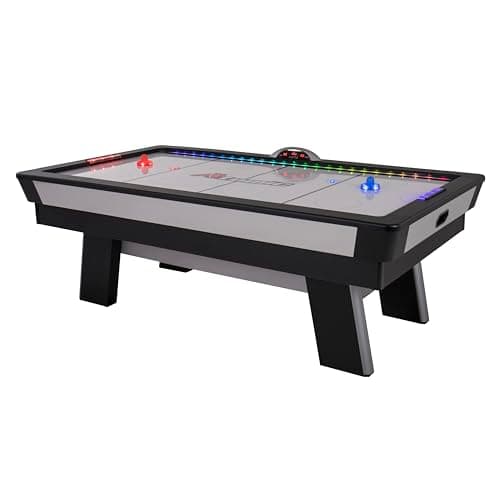 Best surface to keep clean Atomic Top Shelf 7.5 ft Air Hockey Table A sealed laminate playfield that takes repeated wiping. | Family tables that get cleaned often | $949.99$1,099.9914% offView on Amazon |
| 2 | 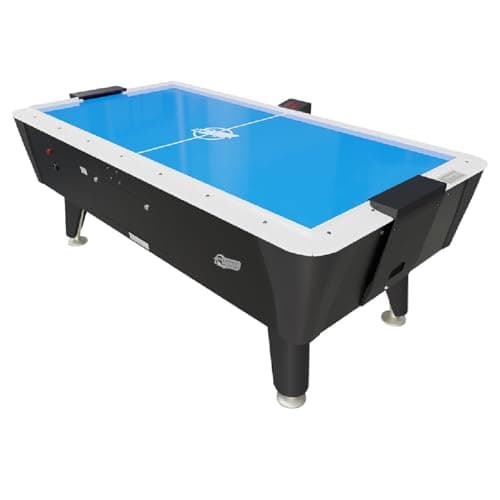 Best airflow by a distance Valley-Dynamo Pro Style Air Hockey Table Commercial-grade blower that simply does not clog in normal use. | Heavy use, and anyone tired of chasing weak airflow | $5,195.00View on Amazon |
| 3 | 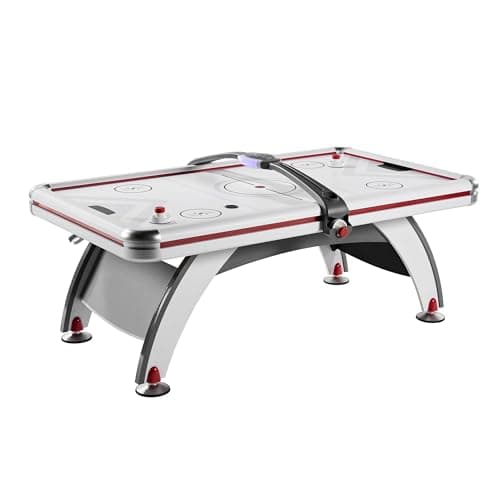 Best full-size home table Rally and Roar 84 in Air Hockey Table An 84in table with the blower to support the area. | A family game room with the floor for a full-size table | $889.99View on Amazon |
#ad · Buy links are affiliate links and we earn a commission on qualifying purchases. Prices and product photographs come from the Amazon listing itself and are refreshed daily; the date they were last checked is shown under each buy button. Where a maker does not sell through Amazon there is no product photo, and the card below says so.
1. Best surface to keep clean
Atomic Top Shelf 7.5 ft Air Hockey Table
Atomic (Escalade Sports)
Cleaning behavior varies with the surface, and the better tables use a hard sealed laminate that tolerates being wiped weekly for years without dulling. Cheaper tables use a thinner printed surface that scuffs and wears through at the high-traffic spots, and once it is through, cleaning makes it worse rather than better.
The other half is the blower. A properly sized blower pushes enough air to keep light dust moving through the holes rather than settling in them, which means the table partly cleans itself in normal use. Weak blowers let dust sit, and dust that sits is dust that cakes.
What we like
- Sealed laminate surface survives repeated cleaning
- Blower strong enough to keep dust moving through the holes
- Full-size playfield with proper rail geometry
- Cabinet rigid enough that the surface stays flat
Worth knowing
- Costs considerably more than an entry table
- Heavy — two people to move or assemble
- Needs a dedicated spot and a hard flat floor
Who it’s wrong for
Occasional play by small children — a smaller table is a better use of the money.
#ad · We earn a commission on qualifying purchases. How this is funded · Price as of November 9, 2026
2. Best airflow by a distance
Valley-Dynamo Pro Style Air Hockey Table
Valley-Dynamo
Commercial tables are built for an arcade, which means they are built to be played constantly in a dusty public room and keep working. The blower is sized accordingly, and the practical consequence at home is that blocked holes stop being a recurring problem rather than becoming a monthly job.
The surface is built to match: thick, sealed, and designed to be wiped down by staff rather than treated gently. If your searching for cleaning advice is really frustration at a table that never glides properly, this is the category that removes the frustration.
What we like
- Commercial blower keeps holes clear in normal play
- Surface built to be cleaned constantly
- Cabinet and rails take abuse indefinitely
- The glide is in a different class
Worth knowing
- Expensive and heavy — a serious purchase
- Needs real floor space and a dedicated power point
- Loud compared with a home table
Who it’s wrong for
A family room where it will see a few games a month. This is far more table than that needs.
#ad · We earn a commission on qualifying purchases. How this is funded · Price as of November 9, 2026
3. Best full-size home table
Rally and Roar 84 in Air Hockey Table
Rally and Roar
A full-size table has more holes to keep clear and more area for dust to settle on, so the blower sizing matters more than on a small table. An 84-inch table with a blower actually matched to the area holds an even glide from end to end, which is the thing cheap large tables fail at.
For cleaning purposes the relevant detail is that a strong even airflow is self-clearing in ordinary use. You will still need to vacuum the holes periodically and wipe the surface weekly, but you will not be doing it because the table has stopped working.
What we like
- Full 84in surface with even glide end to end
- Blower matched to the playfield area
- Electronic scoring and proper goal geometry
- Surface takes weekly cleaning without dulling
Worth knowing
- Needs about 13ft by 8ft of clear floor
- Scoring electronics are the component most likely to fail
- Heavy to assemble; two people required
Who it’s wrong for
A room that cannot clear the footprint plus playing space — see dimensions and space.
#ad · We earn a commission on qualifying purchases. How this is funded · Price as of November 9, 2026
The most common mistake
Why not polish?
It feels intuitive: the puck should glide, polish makes things slippery, therefore polish should help. It does the opposite. The puck is not sliding on the surface — it is floating a fraction above it on air — so surface slickness contributes almost nothing. What polish does contribute is a film that partially seals thousands of tiny holes, which reduces the airflow that the entire game depends on.
The secondary problem is residue. Polish and wax attract and hold dust, so a polished table gets dirtier faster than an unpolished one, and the dust it collects is now stuck to a tacky film rather than being blown free. Within a few weeks the table plays worse than it did before anybody cleaned it, and reversing that means stripping a film off a surface that does not tolerate solvent.
Surface damage
Scuffs, scratches and worn spots
Black marks on the surface are mallet felt or puck plastic transfer, and they come off with a damp cloth and firm pressure. If they do not, a pencil eraser used gently is the safest escalation — it lifts transfer without solvent and without abrading the laminate.
Avoid melamine magic-eraser sponges. They clean by abrading, and on an air hockey surface they both dull the laminate and open up the edges of the holes in the area you scrubbed, which changes the airflow locally. A visible mark is a far better outcome than a patch where the puck behaves differently.
Actual scratches cannot be repaired, and deep ones catch the puck. That is a reason to be strict about two things: no drinks on the playing surface, and nothing hard placed on it between games. The surface is the table.
Troubleshooting
If cleaning does not restore the glide
- Check the table is level. A surface with a twist in it gives uneven glide no matter how clean it is, and basement and garage floors are rarely flat. Adjust the feet and re-check.
- Look for cabinet flex. If the table rocks when you lean on it, the surface is being twisted during play. Tighten the frame hardware.
- Check the blower intake underneath. It has its own filter or grille, and a blocked intake starves the whole table. This is the commonly missed one.
- Listen to the blower. A healthy one is loud and steady. A rising and falling note or a rattle suggests a failing motor or debris in the fan.
- Replace the pucks. Worn pucks develop a lip that catches, which feels exactly like weak airflow.
- Replace the mallet felt. Bald mallets drag on the surface and shed plastic into the holes.
If the table still will not play after all of that, the blower itself may genuinely be failing, and on most home tables it is a replaceable part worth sourcing rather than a reason to replace the table. For how the whole system works and what a good one should feel like, how air hockey tables work explains the mechanics, and our main air hockey roundup covers the tables where blower sizing is done properly in the first place.
If cleaning means moving the table, disassemble rather than carry it: a full-size table is 170 to 300 lb and carrying one assembled racks the cabinet joints, which stops the playfield sitting flat. How much does an air hockey table weigh has the figures and the moving rules.
Questions
Common questions
How do you clean an air hockey table?
How do you clean air hockey table holes?
Can you use polish on an air hockey table?
Why is my air hockey table not blowing air properly?
How do I get scuff marks off an air hockey table?
Keep reading
Read next